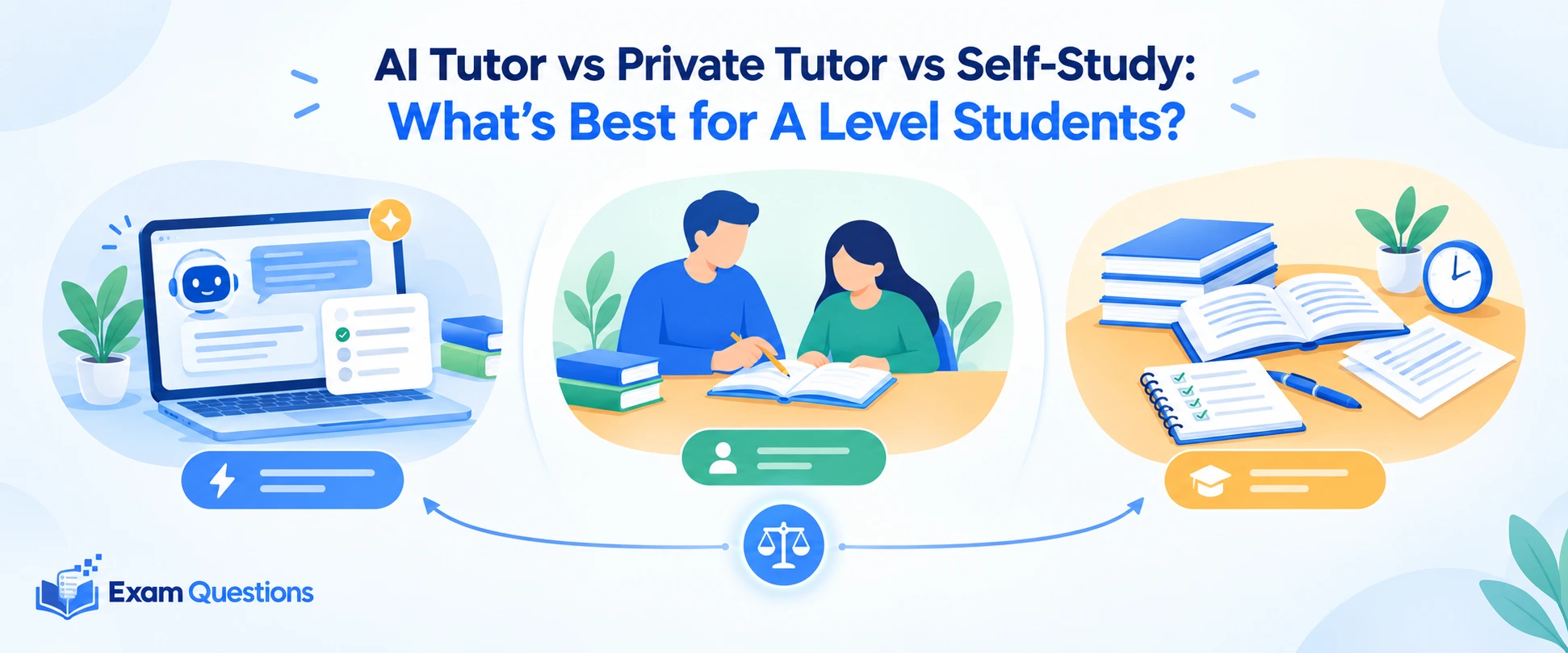
For years the choice at A Level was simple: hire a tutor or work alone. There's now a third option sitting between them, an AI that will answer questions, set practice and comment on your work at any hour. It's cheap to try and it's always awake, which makes it tempting. It also raises a fair question: if an AI can explain things, does anyone still need a tutor?
This guide compares the three approaches, AI-assisted learning, private tutoring and independent study, with a focus on what's new: the role AI plays. We won't repeat the basics of tutor versus self-study, which our guide to A Level tutoring vs self-study covers. Instead we'll look at where an AI tutor genuinely helps, where a human still matters, and how to mix all three. For how to use AI well in the first place, see our main guide to AI exam preparation, and if you're leaning towards a human tutor, our guide to finding the right A Level tutor.
Costs, features and quality vary by tool and by tutor, so treat this as a way of thinking and not a verdict. Keep your syllabus in view as you read, because whichever route you choose, it's the standard everything should be measured against.
What "AI Tutor" Actually Means
The phrase gets used loosely, so it helps to be clear. In practice, an AI tutor is an AI tool you use in a tutoring-like way: you ask it to explain something, to quiz you, to look at an answer or to suggest what to do next. Some are general chatbots with a study mode. Some are platforms built around a particular exam. Neither is a person, and neither knows you the way a human tutor eventually does.
That difference is the heart of the comparison. An AI tutor can behave like a very patient explainer with an unlimited question bank. It can't notice that you looked confused, that you always rush calculations, or that your school covers a topic in a different order. Those are things a person picks up.
The Three Approaches Side by Side
The table below compares them on the things students ask about most. It uses plain descriptions, not scores, because the right answer depends on your situation.
| AI-assisted learning | Private tutor | Independent study | |
|---|---|---|---|
| Availability | Any time, instantly | Fixed sessions, limited by their schedule | Whenever you choose |
| Explanations | Patient, can try several angles, can be wrong | Adapts to how you think, can spot why you're stuck | Books and notes, no one to ask |
| Practice | Almost unlimited, quality varies | Selected for your needs, limited by session time | Past papers and textbook questions |
| Feedback | Fast, useful for gaps, not always accurate | Judged by someone who knows the standard | Only what you can check yourself |
| Knows you | Only what you tell it in the chat | Learns your habits and weaknesses over time | You know yourself best, but can be blind to your own gaps |
| Accountability | None unless you build it | Strong: someone expects your work | Depends entirely on you |
| Cost | Free and paid options; check current terms | Usually the largest cost | Mostly your time |
| Main risk | Confident mistakes and passivity | A poor match, or dependence | Repeating errors without noticing |
Where an AI Tutor Genuinely Helps
Late-night questions. Stuck at ten in the evening with no one to ask? An AI can unblock you that night.
Endless practice. After you've run out of questions, it can generate more on the same topic, at the difficulty you choose.
Repeated explanations without embarrassment. You can ask the same question five times in five ways and never feel judged.
Quick feedback on a draft answer. It can point out what's missing before you've waited a week for a marked paper.
Planning and structure. Turning a long topic list into a realistic schedule is a task it does well.
In each case, AI adds something a tutor or a book can't offer at that moment: speed, volume or patience. That's real value, as long as you stay the one doing the thinking.
Where an AI Tutor Falls Short
It doesn't know your exam. It hasn't seen your mark scheme, and it may blend in content from other boards or levels.
It can be confidently wrong. A fluent explanation of a wrong idea is easy to absorb.
It rarely diagnoses why you're stuck. A good tutor asks a few questions and finds the missing foundation. An AI often just explains the topic again.
It doesn't hold you to anything. Nothing happens if you skip a week.
It can't see you. It doesn't notice stress, tiredness or the moment you've stopped understanding.
Our guide on whether AI can help with A Level exam preparation goes through these limits in more detail, including why checking what it says is part of using it responsibly.
Where a Private Tutor Still Matters
There are a few things a human does that current AI tools do poorly, and they tend to matter most when you're really struggling.
- Diagnosing the real gap. Often a student is stuck on a topic because of a weakness two topics earlier. A tutor finds it by watching you work.
- Knowing the exam board and the examiners. An experienced tutor knows how questions are worded and marked, and which answers lose marks.
- Adapting to you. They change pace, switch explanations and notice when you're only nodding.
- Motivation and accountability. A set session and someone expecting your work keeps many students going.
- Judgement and reassurance. A person can tell you when you're doing fine and when you aren't.
If you do decide to hire one, our guide to finding the right A Level tutor explains what to look for, and it's worth reading before you book anyone.
Where Independent Study Still Does the Heavy Lifting
Neither an AI nor a tutor can learn for you. The retrieval, the writing and the practice under timed conditions are yours. Independent study with real past papers and your syllabus remains the backbone, and the other two are supports around it.
Use past papers, topic questions and your own error log to see where you stand. If you're short of structure, a tutor or an AI can help you set it up, but the work itself is something you do.
What an Hour Looks Like With Each
Seeing a typical session side by side makes the difference concrete. These are generalisations, and individual tutors and tools vary.
An hour with an AI tutor. You choose a topic, ask for questions, answer them and read feedback, perhaps asking follow-ups. It's quick and flexible, and the pace and rigour depend largely on you.
An hour with a private tutor. The tutor looks at what you've brought, asks you to explain something, notices where you hesitate, sets a task to try and discusses it. The structure comes from them, and so does the pressure to keep going.
An hour alone. You work through past-paper questions, mark them against a scheme and log your mistakes. It's the most independent, and the most dependent on your own discipline.
Match the Approach to the Problem
| Your situation | What tends to help most | Why |
|---|---|---|
| You understand lessons but need more practice | Independent study, with AI for extra questions | The gap is volume, which AI supplies cheaply |
| You're stuck on one concept and nothing is helping | A tutor or your teacher, with AI for a second explanation | A person can find the missing foundation |
| You lose marks on technique | A tutor or teacher marking your answers, plus real mark schemes | Judgement about standards matters here |
| You study alone and need quick answers | AI for quick queries, a teacher for anything persistent | Speed is useful, but check what matters |
| You struggle to start or stay consistent | A tutor or study partner for accountability | AI won't hold you to a routine |
| You have little time before the exam | A short tutor block on the weakest topic, AI for practice | Focus the expensive help where it counts most |
Signs It's Time to Bring in a Person
AI can carry you a long way, but there are signals that you've reached the point where a human would help more.
- You've asked an AI to explain the same topic several ways and it still doesn't make sense.
- Your marks have stalled even though you practise regularly and check your work.
- You keep losing marks on wording and technique and can't see why.
- You notice the AI giving explanations that contradict your textbook or teacher.
- You're feeling stressed, overwhelmed or unmotivated, which no tool can properly address.
At that point, speak to your teacher first, since they know your course and cost nothing, and consider a tutor if you need more focused help.
Combining All Three
The strongest setups tend to use each approach for what it's good at. A common pattern: independent study as the foundation, AI for extra practice and quick questions, and a tutor or teacher for diagnosis, technique and accountability.
- 1
Start with the syllabus and past papers. They tell you what's examined and how you're doing.
- 2
Use AI for volume and quick help. More questions, second explanations and a draft timetable. Our guide to how to use AI for A Level revision shows a routine to follow.
- 3
Bring the stubborn problems to a person. If something hasn't improved after a fair try, ask your teacher or a tutor.
- 4
Review the mix every few weeks. If marks are flat, change the balance.
If you're building a plan across all of these, our guide to creating an A Level revision timetable with AI shows how to fit them into a realistic week.
What About Tutors Who Use AI?
Some tutors now use AI themselves, to prepare questions, draft explanations or save time on admin. That isn't necessarily a problem, and it can even be a benefit if the tutor checks the output and uses it to give you more practice.
It's reasonable to ask how they use it. A good answer sounds like: "I use it to generate extra questions and always check them against the syllabus and mark scheme." A worrying answer is one where the lesson is mostly reading AI output aloud. What you're paying for is judgement and experience, not a relay of a chatbot's text.
Cost and Time Compared
We won't quote figures, because they differ by tool, tutor and country, and they change. As a rule, independent study costs mostly time, AI tools range from free to paid plans, and private tutoring usually adds the largest fees and sometimes travel.
Price shouldn't be the only test, though. A cheap tool you use passively teaches little, and an expensive tutor you can't keep up with doesn't either. Ask what you'd actually do with the hours, and pick what you'll use consistently. Our comparison of the best AI tools for A Level exam preparation explains how to check pricing before you commit.
Rules, Honesty and Safety
Whichever help you use, the work you submit as your own must be yours, and AI isn't available in exams. Check your school's and exam board's rules on AI for assignments and coursework, and ask your teacher if you're unsure.
Be careful with personal information, too. Read what an AI tool does with your data, and with a private tutor, make sure a parent knows who they are and where lessons take place.
Three Students, Three Mixes
Hamza, strong but short of practice. He understands his lessons and needs volume. He studies from past papers and uses an AI to generate extra questions on weak topics. He doesn't need a tutor.
Areeba, stuck on a concept. Two weeks of notes and AI explanations haven't helped. A tutor discovers she never understood an earlier topic. A short block of sessions fixes it, and she goes back to self-study with AI for practice.
Daniyal, who needs accountability. He knows the material but keeps putting work off. A weekly session with a tutor and a simple AI-built timetable give him structure, and his practice papers improve.
A Note for Parents
It's easy to assume that a tutor is the safe choice and AI is a gimmick, or the reverse. Neither is automatically right. A useful approach is to look at what your child actually needs: more practice, a clearer explanation, better exam technique or more accountability. Then ask which approach supplies it at a cost the family can sustain.
Look at the evidence together: recent marks, how your child uses each help and whether it's changing what they can do. And remember that no tool or tutor can promise a grade.
Mistakes to Avoid
- 1
Choosing by hype. Both AI and private tutoring are sold with big promises. Judge by what changes in your marks.
- 2
Replacing all human help with AI. A person finds problems an AI misses.
- 3
Paying for a tutor to do the work. Lessons only help if you practise between them.
- 4
Trusting AI without checking. Verify what affects marks against your syllabus and mark schemes.
- 5
Never reviewing the mix. Your needs change over the course, so revisit your choice each term.
Questions to Ask Before You Decide
- What exactly am I stuck on, and have I tried to fix it myself?
- Is my problem volume, understanding, technique or accountability?
- Can I check an AI's answers, or do I need someone who can?
- What can I realistically keep up every week?
- How will I know in a month whether this is working?
Final Thoughts
AI tutors, private tutors and independent study aren't rivals. Each solves a different problem. AI offers availability, patience and practice, a tutor offers diagnosis, standards and accountability, and independent study builds the skill that no one can do for you. The best mix is the one that fits where you're stuck.
To go deeper, read our guide to AI exam preparation, see A Level tutoring vs self-study and finding the right A Level tutor, and use our A Level practice pages to put it to work.
Practise the subjects you choose
Work through topic questions and past papers for your A Level subjects, and get your answers marked with the reasoning behind each mark.