Ask ten A Level students how they use AI to revise and you'll get ten different answers. Some paste a topic into a chatbot and ask for a summary. Some ask it to write their essay answers. A few use it the way a good tutor would: to test them, spot their weak points and push them to explain things in their own words. The tool is the same in every case. The results aren't.
This guide is about the third group. It explains what AI exam preparation actually involves, where it helps most, where it lets you down, and how to fit it into a routine built around your syllabus and real past papers. It covers question generation, active recall, feedback on your answers, revision planning and how AI supports, but never replaces, past-paper practice.
Everything here assumes you're preparing for Cambridge International A Levels, which is what most students in Pakistan sit, and that you want to improve your understanding as well as your marks. Browse the A Level subjects as you read, and check your own syllabus for the details that apply to you. If you're also comparing tools, see our guide to the best AI tools for A Level exam preparation. To turn the ideas into a session you can repeat, see how to use AI for A Level revision.
What AI Exam Preparation Actually Means
The phrase covers a lot of ground, so it helps to be specific. In practice, AI exam preparation means using an AI tool for one or more of these jobs: explaining a concept in a different way, generating practice questions on a topic, checking your answers and showing where you lost marks, helping you plan what to revise and when, and turning your mistakes into the next round of practice.
What it doesn't mean is asking an AI to do the work. A summary you didn't write and an answer you didn't attempt feel productive, but they leave your memory and your exam technique exactly where they were. The useful version of AI revision is the one where you're still the one answering.
Why Staying Active Matters
Decades of research on learning point the same way: you remember what you retrieve, not what you reread. Pulling an idea out of your head, even imperfectly, strengthens it far more than looking at it again. That's why practice questions, flashcards and explaining a topic aloud beat highlighting and rereading.
AI is good at supporting that kind of work, because it can produce an endless supply of questions and respond to your answers straight away. It's poor at replacing it. If you let the tool do the retrieving, you've handed over the part that does the learning.
Start With the Syllabus, Not the Chatbot
An AI tool doesn't know exactly what your exam board expects. It knows a lot about the subject in general, and some of it won't match your syllabus: extra content, different wording or a different level of depth. That mismatch is one of the main ways AI revision goes wrong.
So begin with the official document. Use your syllabus pages and topic pages to see what's actually examined, then bring that list to the AI. Tell it the subject, the topic and the exam board. Asking "Explain this learning objective" will get you a much better answer than asking it to "teach me chemistry."
Five Jobs AI Can Do Well
Explain it another way. If a textbook paragraph didn't land, ask for the same idea with an analogy, a diagram description or a worked example.
Generate practice questions. On a topic you choose, at a difficulty you set, as many as you need.
Give feedback on an answer. Compare what you wrote with the idea the question was after, and point to what's missing.
Plan your revision. Turn a list of topics and a deadline into a realistic weekly schedule.
Quiz you. Ask one question at a time, wait for your answer and follow up on the gaps.
Using AI to Generate Practice Questions
This is where AI earns its place. Once you've finished the questions in your textbook and the past papers you have, you often hit a wall: you want more practice on one specific topic and there's nothing left. AI can fill that gap.
The quality of the questions depends on the quality of the request. Vague prompts give vague questions, and the difference is easy to see.
| Weak prompt | Stronger prompt | Why it works better |
|---|---|---|
| Give me chemistry questions | Write five exam-style questions on chemical equilibrium for Cambridge A Level Chemistry, mixing short answers and one calculation | Names the topic, board, style and mix |
| Test me on economics | Ask me one question at a time on price elasticity of demand, wait for my answer, then tell me what I missed | Keeps you answering, one step at a time |
| Make a physics paper | Write three structured questions on circular motion with marks shown, at about the difficulty of a past paper | Sets the format and the difficulty |
Treat generated questions as extra practice, not as a prediction. An AI can't know what a future paper will ask, and any tool that claims it can should make you cautious. What it can do is give you more chances to apply the same skill in a slightly different way.
Active Recall With AI, Step by Step
- 1
Close your notes. Pick a topic and write down everything you remember, or answer a few questions from memory.
- 2
Ask the AI to quiz you. Request one question at a time, so you can't skim ahead.
- 3
Answer before you ask. Write or say your answer first. Only then look at the feedback.
- 4
Note what you missed. Record the gaps in a list you'll return to.
- 5
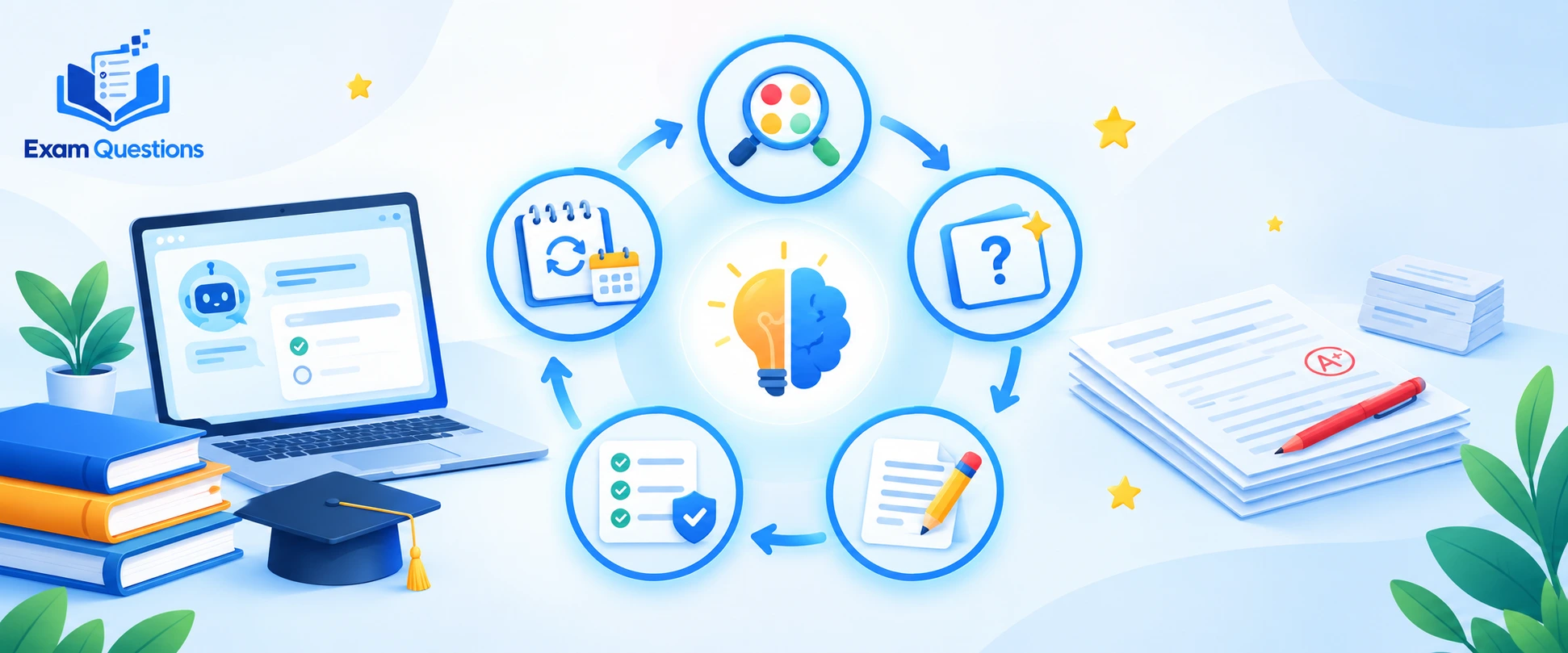
Repeat after a gap. Come back to the same topic after a day or a few, and see whether the gaps have closed.
The spacing matters as much as the questions. Seeing a topic again after a short break, when it has partly faded, is what builds lasting memory. Our guide to how to use AI for A Level revision shows how to build that into a routine.
Getting Feedback on Your Answers
Feedback is the other big benefit. After you write an answer, an AI can tell you what you got right, where your reasoning broke down and what a stronger answer would include. That's especially useful for theory questions, where it's hard to know why a response might lose marks.
There's a limit, though. Examiners mark against a mark scheme with specific points and wording, and an AI doesn't always follow it exactly. It may be kinder than an examiner, or stricter. Use it to understand your thinking and spot gaps, then compare your answer with the real mark scheme from a past paper to see how marks are actually awarded.
- Paste the question and your answer, and ask what's missing rather than for a score.
- Ask it to point out any step in your reasoning that doesn't follow.
- Ask for a stronger version only after you've tried to improve your own.
- Check the final judgement against the mark scheme, not the AI's opinion alone.
Planning Your Revision With AI
Planning is a good job to hand over, because it's about organising, not understanding. Give the AI your subjects, your list of topics, how many weeks you have and how many hours you can realistically study, and ask for a weekly schedule.
Then edit it. Move sessions around your real commitments, shorten anything that looks too ambitious and build in rest. A plan you can keep is better than a perfect one you abandon. Here's the shape of a sensible week for a student with one demanding subject:
| Day | Session | What to do |
|---|---|---|
| Monday | 40 minutes | Learn or re-learn one topic from the syllabus list |
| Wednesday | 40 minutes | Questions on that topic: first with notes, then without |
| Friday | 30 minutes | AI quiz on the week's topics, then review your mistakes |
| Saturday | 60 minutes | A timed section from a past paper, marked with the mark scheme |
| Sunday | 15 minutes | Plan next week and tick off what's done |
Past Papers Still Come First
No amount of AI practice replaces real exam questions. Past papers show you how examiners phrase questions, how marks are split and how much you're expected to write. They're also the best test of whether your revision is working.
AI can make past papers more useful, not less. After a paper, paste in a question you got wrong and ask why your approach failed. Ask for a similar question to try again. Ask it to explain a mark scheme point you didn't follow. Our A Level past papers and A Level questions pages are a good place to start, and a few papers kept back for later give you a reliable check as the exams approach.
A Worked Example: One Topic, One Hour
Here's how the pieces fit together in a single session. Imagine a student revising the topic of electrolysis in A Level Chemistry.
- 1
Minutes 0 to 10: from memory. Write down what happens at each electrode and the factors that change the product. Check against the syllabus list.
- 2
Minutes 10 to 20: fill the gaps. Read the notes or ask the AI to explain the one idea that didn't make sense.
- 3
Minutes 20 to 40: practice. Ask for five questions, one at a time, mixing short answers and a calculation. Answer each before looking at feedback.
- 4
Minutes 40 to 50: a real question. Do one past-paper question on the topic, timed, then mark it with the mark scheme.
- 5
Minutes 50 to 60: log it. Write down the mistakes and what to revisit, so the next session starts there.
Notice that the student is answering for most of the hour. The AI explains, asks and responds, but the retrieving and the writing are the student's.
Prompts That Work
You don't need clever tricks. Clear, specific requests with the right context do the job. A few patterns you can adapt:
To understand. "Explain [topic] for Cambridge A Level [subject] as if I'm new to it, then give me one worked example."
To practise. "Ask me one exam-style question at a time on [topic]. Wait for my answer and tell me what I missed."
To review. "Here is the question and my answer. What did I leave out, and where does my reasoning go wrong? Don't give me the full answer yet."
To plan. "I have [number] weeks and [number] hours a week for [subjects]. Here are my topics. Suggest a weekly plan I can adjust."
The Limits You Need to Know
AI is a useful study partner and an unreliable authority. Knowing where it fails keeps you from learning something wrong.
It can be confidently wrong. AI sometimes states a mistake as fact, especially with calculations, definitions and recent changes.
It may not match your syllabus. It can include content, terms or methods your exam board doesn't use.
It doesn't know your exam. It can't predict the next paper, and it doesn't see the examiner's mark scheme.
It can make you passive. If you read answers instead of writing them, your revision feels easy and teaches little.
It isn't a replacement for teachers. Your teacher knows your course, your school's expectations and your strengths.
How to Check What AI Tells You
- 1
Compare with your textbook or notes. If they disagree, trust the textbook and the syllabus.
- 2
Redo the calculation yourself. Don't accept a number you haven't checked.
- 3
Look for the syllabus wording. If the AI uses a term that isn't in your syllabus, ask your teacher whether it matters.
- 4
Check against a mark scheme. For anything about how marks are given, use the real thing.
- 5
Ask it to show its reasoning. A step-by-step explanation is easier to catch mistakes in than a bare answer.
Where Exam Questions Fits In
Using a general chatbot for revision works, but it takes effort. You have to supply the syllabus, write careful prompts, keep track of what you've covered and double-check what comes back. Exam Questions is built to take some of that work off you while keeping the same principle: you do the practice, the tool supports it.
The platform is focused on Cambridge International A Level subjects. It brings together exam-style multiple-choice and theory questions, past-paper practice, AI-generated questions based on textbook content, and AI-assisted marking with explanations, so you can practise a topic, see where you went wrong and try again without switching between tools. You can read more about how it works on our AI exam preparation page, and try the A Level practice pages to see it in use. If you're weighing it against other tools, our guide to the best AI tools for A Level exam preparation compares them on the same criteria.
It's an additional way to practise, not a replacement for your teachers, textbooks or official resources, and it can't promise what any future exam will ask. Keep using your syllabus and real past papers alongside it.
Common Mistakes to Avoid
- 1
Asking for summaries all day. They feel like progress, but you haven't retrieved anything.
- 2
Skipping the attempt. Looking at the answer before trying is the quickest way to learn little.
- 3
Trusting everything. Check calculations, definitions and anything that affects marks.
- 4
Ignoring past papers. AI practice is extra. Real papers are the standard.
- 5
Using it for everything. Some tasks, such as planning and quizzing, suit AI. Deep understanding of a hard idea often needs a teacher or a textbook.
A Simple Weekly Routine
If you want a starting point, this pattern works for many students and is easy to adjust.
- Early in the week: learn or re-learn a topic using your notes, with AI to explain anything unclear.
- Midweek: practise it with generated questions, answering before you check.
- Late in the week: a timed past-paper section on the same topic, marked with the real mark scheme.
- Weekend: review your error log, redo the questions you missed and plan the next week.
Questions to Ask Yourself Before You Open an AI Tool
- Which syllabus topic am I working on, and what exactly should I be able to do by the end?
- Am I about to answer something, or about to read an answer?
- How will I check whether what I learn is correct?
- What will I do afterwards to make sure it sticks?
Final Thoughts
AI exam preparation works when it keeps you in the driving seat. Use it to explain, to quiz, to give feedback and to plan, while you do the retrieving, the writing and the checking. Let your syllabus and real past papers set the standard, and treat everything the AI says as something to verify.
If you'd like to put this into practice, explore our AI exam preparation page, work through the A Level questions and practice pages, and keep your past papers close. A little structured practice, repeated over weeks, does far more than a night of rereading.
Practise the subjects you choose
Work through topic questions and past papers for your A Level subjects, and get your answers marked with the reasoning behind each mark.