There's a familiar trap in revision. You read a page, it all makes sense, you close the book and feel ready. A week later, a question appears that wears the idea differently, and the page you "knew" is nowhere to be found. Recognising something when you see it is not the same as being able to use it, and A Level papers are written to test the second.
AI can make that trap worse, because it hands you tidy explanations on demand and makes passive reading feel productive. It can also help you out of it, if you use it to make yourself do more thinking. This guide lays out one session you can repeat for any topic: find a weak spot, generate questions, answer them on your own, check the feedback and come back to your mistakes. It builds on our wider guide to AI exam preparation, and if you haven't chosen a tool yet, our comparison of the best AI tools for A Level exam preparation can help.
Everything below assumes Cambridge International A Levels and a syllabus you've actually read. Keep your syllabus and a few past papers beside you, because the whole routine is built around them.
Why Memorisation Alone Lets You Down
Memory matters. You need definitions, formulae and key terms at your fingertips. But A Level questions rarely ask you to repeat something. They ask you to explain why a result happens, apply a method to a situation you haven't seen, compare two ideas or judge an argument. A student who has only memorised the facts can lose marks on every one of those.
There are really three levels of knowing a topic, and it helps to be honest about which one you're at.
Recognising. You see the answer and think "yes, that's right." This is the weakest level and the easiest to fool yourself with.
Recalling. You can produce the fact or the method from memory, without a prompt.
Using. You can apply it to a new question, explain why it works and spot when it doesn't.
Good AI revision pushes you from recognising towards using. That's the test for any technique in this guide: does it make you produce something, or only look at something?
The Session at a Glance
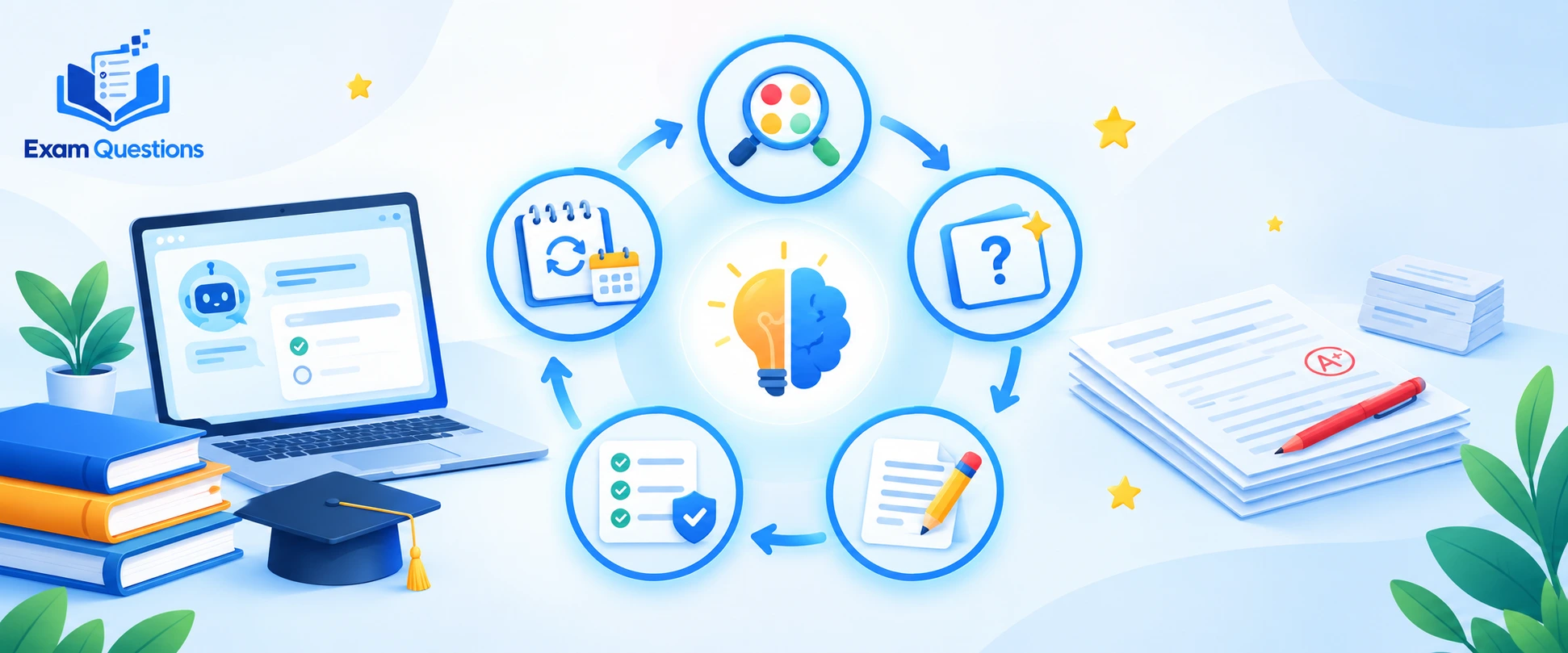
One session covers one topic and takes about an hour. Here are the five stages, with a rough time budget you can shrink or stretch.
| Stage | What you do | About |
|---|---|---|
| 1. Find the weak spot | Choose one topic where your marks or confidence are low | 5 minutes |
| 2. Generate questions | Ask the AI for questions that test understanding | 5 minutes |
| 3. Attempt on your own | Answer from memory, in writing, before any feedback | 25 minutes |
| 4. Check the feedback | Read the AI's feedback, then verify it against real sources | 15 minutes |
| 5. Log and plan | Record the mistakes and schedule the next visit | 10 minutes |
Notice where the time goes. Most of it is you answering and checking, not the AI talking. If you find yourself reading more than writing, the session has drifted.
Stage One: Find a Weak Topic Worth Revising
Revising what you already know feels pleasant and changes little. The marks are in the topics you avoid. Start by finding them.
- Look at marked work. Which topics keep appearing next to lost marks?
- Traffic-light your syllabus. Mark each topic green, amber or red honestly. Our topic pages give you a clean list to work from.
- Try a short past-paper section. Where you stall is where to start.
- Pick one red topic. Not three. A single topic you finish beats three you skim.
If you're unsure which topics are weakest, the AI can help you check, as long as you answer first. A prompt such as the one below turns it into a diagnostic instead of a lecture.
"I'm revising Cambridge A Level Physics. Ask me six short questions, one at a time, across different topics in the syllabus. After each answer, don't tell me if I'm right until the end. At the end, list the topics I seem least sure about."
Stage Two: Generate Questions That Test Understanding
The type of question decides the type of thinking. Ask only for "questions on osmosis" and you'll probably get definitions. Ask for the right mix and you'll practise what the exam asks.
| Question type | What it tests | Ask the AI for |
|---|---|---|
| Recall | Can you produce the fact or term? | Short questions on definitions and key facts |
| Explain why | Do you understand the cause? | Questions that start with why or how |
| Apply | Can you use it in a new setting? | A scenario you haven't seen, with a question about it |
| Compare | Can you separate two similar ideas? | A question asking for similarities and differences |
| Spot the error | Do you know what's wrong and why? | A worked answer containing a mistake, which you must find |
"Spot the error" is especially useful and often overlooked. Reading a flawed solution and explaining what's wrong forces you to understand the method, not just follow it.
"Write five exam-style questions on [topic] for Cambridge A Level [subject]: one recall, two that ask me to explain why, one applying the idea to a new situation and one containing a worked answer with a mistake for me to find. Show marks for each. Don't give the answers yet."
Stage Three: Attempt Answers Independently
This is the stage that does the learning, and the one most often skipped. The temptation to peek is strong, because the answer is a click away.
- 1
Close your notes and the AI's answers. Retrieval only works if you're retrieving.
- 2
Write the full answer. Not a vague plan or a quick thought. Writing exposes gaps that thinking hides.
- 3
Time yourself. Use roughly one minute per mark, as in a real paper.
- 4
Rate your confidence. Next to each answer, note whether you felt sure, unsure or guessing. It shows you where your feeling and your marks disagree.
- 5
Stop and put the pen down. Only now look at feedback.
Stage Four: Check the Feedback, and Check the Feedback
Paste your answer in and ask what's missing. That's the useful part. The second job is just as important: checking that the feedback itself is right.
AI tools write fluently, and fluency is persuasive. An answer can sound authoritative and still contain a wrong number, a definition from another syllabus or a step that quietly doesn't follow. If you accept it without checking, you may revise a mistake into memory. That's the main reason to verify, and the cost is small compared with the harm.
- 1
Compare with your textbook or notes. If they disagree, trust the textbook and your syllabus.
- 2
Redo the calculation yourself. Don't copy a number you haven't checked.
- 3
Check the wording against the mark scheme. Real mark schemes show the exact points that earn marks.
- 4
Ask the AI to justify itself. "Show me where in the syllabus this appears" or "explain each step" often exposes a weak answer.
- 5
When in doubt, ask your teacher. A two-minute question can save weeks of confusion.
"Here is the question and my answer. What did I miss or get wrong? Point to the specific step that fails, but don't write the full answer. Then give me one similar question to try."
Stage Five: Turn Mistakes Into the Next Session
A mistake you correct and forget will return. A mistake you log and revisit rarely does. Keep a simple error log, and use it to decide what the next session should be.
| Type of mistake | What it looks like | What to do next |
|---|---|---|
| Knowledge gap | You didn't know the fact or term | Add it to flashcards and test yourself in two days |
| Method error | You used the wrong approach | Rewrite the correct method, then try a similar question |
| Misread question | You answered a different question | Underline command words next time and re-read before writing |
| Careless slip | A unit, sign or copying error | Add a checking step to your routine |
| Weak explanation | Right idea, but marks lost for reasoning | Rewrite it in full sentences and compare with a model answer |
Ask the AI to help turn the log into practice: "Here are my last five mistakes on [topic]. Write three new questions that target the same weaknesses." The next session starts exactly where you struggled.
Spacing Without a Spreadsheet
Seeing a topic again after a gap, when it's partly faded, helps it stick far more than repeating it straight away. You don't need software for this, just a rough rhythm.
- Day one: the full session on the topic.
- A couple of days later: a short check with a few questions from memory.
- About a week later: another short check, mixed in with a different topic.
- A few weeks later: a past-paper question on the topic, timed and marked.
Those gaps are a guide, not a rule, and you can adjust them to your timetable. If you'd like help scheduling, ask the AI to turn your list of topics and your exam date into a calendar, then edit it until it fits your real week.
Techniques That Build Understanding
Teach it back. Explain the topic to the AI as if it knew nothing, then ask it to question you about anything unclear. You'll find out fast what you can't explain.
Predict, then check. Before looking at a result, write what you expect and why. Then compare.
Fade the worked example. Study a worked solution, then try one with a step removed, then one with none.
Compare and contrast. Ask for the differences between two easily confused ideas, then write them in your own words.
Mix topics. Interleaving questions from several topics makes you choose a method, which is what the exam demands.
A Full Session, Start to Finish
Here's what the loop looks like for a student whose marks keep dropping on chemical equilibrium in A Level Chemistry.
- 1
Weak spot. Her last two papers lost marks on equilibrium, so it goes red on her topic list. She picks it for tonight and nothing else.
- 2
Questions. She asks for five questions: one recall, two on why the position of equilibrium shifts, one calculation and one worked answer with an error in it.
- 3
Attempt. Notes closed, she writes full answers in twenty-five minutes and marks how sure she felt about each. She is confident about the calculation and unsure about both "why" questions.
- 4
Feedback and check. The AI points out that her explanation of temperature changes ignored whether the reaction is exothermic. She checks that against her textbook and the mark scheme from a past paper, and confirms the AI was right on the principle but loose in its wording.
- 5
Log. She records the mistake as a weak explanation, writes the corrected version in her own words, and schedules a short check in two days.
Two things stand out. She was unsure exactly where her marks were being lost, so the confidence ratings did real work. And the AI's wording needed her own check, which is why that stage is part of the routine.
Sample Prompts for Each Stage
Adapt these to your subject. Put the topic, subject and board in every prompt, so the AI isn't guessing.
| Stage | Prompt to adapt |
|---|---|
| Find the weak spot | "Ask me one question at a time across the topics in [subject]. Don't reveal answers until the end, then list my weakest topics." |
| Generate questions | "Write five exam-style questions on [topic] for Cambridge A Level [subject], mixing recall, explain why and apply. Show marks. No answers yet." |
| Attempt | "Wait until I send my answers before saying anything." |
| Feedback | "Here are the question and my answer. What did I miss? Point to the failing step, but don't write the full answer." |
| Log and revisit | "Here are my mistakes. Write three new questions that target the same weaknesses, and tell me which type of mistake each one is." |
The Same Session in Two Different Subjects
A calculation subject, such as Physics. Pick a topic like circular motion. Generate questions with a mix of calculation and explanation. Attempt them with units written out. Check numbers yourself before trusting the AI's. Log whether errors were method, units or arithmetic.
A written subject, such as Economics or Sociology. Pick a topic like price elasticity or research methods. Generate questions that ask you to evaluate, not just describe. Write a full paragraph per answer. Ask the AI where your argument is thin, then compare with a real mark scheme for the style expected.
When AI Gets in the Way
- You're reading, not writing. If most of the session is the AI's text on your screen, you're being taught at, not learning.
- You ask for the answer first. That removes the retrieval, which is the useful part.
- Every answer feels convincing. If you've stopped checking anything, you've started trusting by habit.
- It replaces the real thing. AI practice is extra. Real past papers set the standard.
A Four-Week Starter Plan
| Week | Focus | What to do |
|---|---|---|
| 1 | Build the habit | Run the five-stage session on one weak topic, twice. Start the error log. |
| 2 | Add spacing | Revisit week one's topic with a short check. Run a session on a second topic. |
| 3 | Mix and time | Do mixed questions across three topics, timed. Check with a real mark scheme. |
| 4 | Test yourself | Do a past-paper section on your weakest topic and compare your marks with week one. |
How Much AI Is Enough?
Not as much as you might think. The routine above needs the AI for perhaps a quarter of the session: setting questions, responding to your answers and helping you plan. The rest is you, a pen, a mark scheme and your own notes.
If a week goes by in which you've used AI daily but written very little, that's a sign to adjust. A smaller, more active use beats a larger passive one. Two or three focused sessions a week, alongside timed past-paper practice, is a reasonable aim for most students.
Mistakes to Avoid
- 1
Skipping the attempt. Looking at feedback before writing an answer defeats the exercise.
- 2
Only asking for recall. Mix in explain, apply and spot-the-error questions.
- 3
Never checking the AI. Verify numbers, wording and anything that affects marks.
- 4
Revising too many topics at once. One topic per session keeps it manageable.
- 5
Forgetting the log. Without it, the same mistakes come back.
Questions to Ask Yourself After Each Session
- Did I answer before I looked at any feedback?
- Which mistake did I make, and what type was it?
- Did I check the AI's feedback against a trusted source?
- When will I come back to this topic?
- Could I now explain it to someone without notes?
Final Thoughts
Revising with AI works best when it makes your own thinking harder, in a useful way. Find the weak spot, ask for questions that test understanding, answer on your own, check the feedback and log what you got wrong. Repeat it, with gaps, and the topic moves from something you recognise to something you can use.
For the bigger picture, read our guide to AI exam preparation, and if you're choosing a tool, see the best AI tools for A Level exam preparation. Then put it to work with real questions from our A Level practice and past papers pages.
Practise the subjects you choose
Work through topic questions and past papers for your A Level subjects, and get your answers marked with the reasoning behind each mark.