If you're unsure whether AI belongs in your revision, you're in good company. Some students swear by it. Some teachers worry about it. Parents hear stories about chatbots inventing facts, and about other students using them to do their homework. It's reasonable to ask whether it's actually worth your time, and whether it could do you harm.
The honest answer is that AI can help with A Level preparation in some specific ways, and can mislead you in others. This guide goes through both: the real benefits, the ways it goes wrong, why your syllabus matters so much, the risk of leaning on it too hard and where academic integrity comes in. If you want the practical side, our guides to AI exam preparation and how to use AI for A Level revision show how to use it well, and our comparison of the best AI tools for A Level exam preparation helps you choose one.
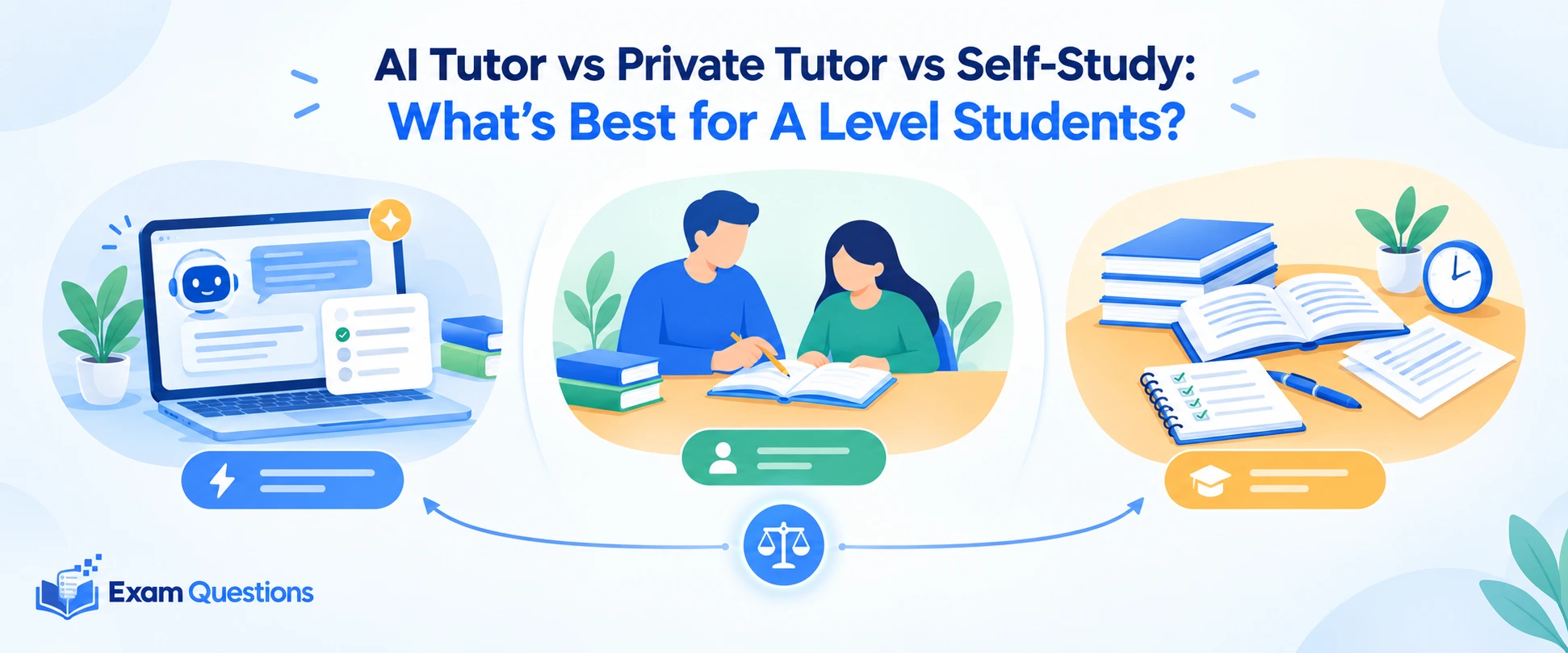
We build an AI-assisted study platform, so we have a view, and we've tried to be straight about the limits. Keep your syllabus in front of you as you read, because it's the standard against which everything an AI says should be checked. If you decide to use AI for planning, see how to create an A Level revision timetable with AI. For AI versus a human tutor, see AI tutor vs private tutor vs self-study for A Levels.
The Short Answer: Yes, With Conditions
AI helps when it makes you do more of the right kind of work. It hurts when it does the work for you or when you trust it without checking. That single distinction explains most of the good and bad stories you'll hear.
A student who asks an AI to quiz her, answers on paper, then compares her answers with a mark scheme is using it well. A student who pastes in a question, copies the answer and moves on has learned nothing and may have copied an error. Same tool, opposite results.
Where AI Genuinely Helps
A second explanation. When a textbook paragraph doesn't land, an AI can explain the same idea with a different example or at a different level, and answer follow-up questions straight away.
Practice when you've run out. After you've done the questions in your textbook and the past papers you have, AI can produce more on the same topic.
Feedback at any hour. You can check an answer at ten at night, when no teacher is available, and find out what you left out.
Planning. Turning a list of topics and an exam date into a weekly schedule is a job it does quickly.
Language support. If you study in English as a second language, it can rephrase a confusing question or explain a term in simpler words.
None of these replaces your own effort. Each one saves time or opens a door, and then you still have to do the learning.
When It Helps: A Few Examples
| Situation | Why AI helps | What to check it against |
|---|---|---|
| You don't follow a worked example in your textbook | It can walk through the steps and explain why each one is taken | The textbook's own method and your teacher |
| You've finished your topic questions and want more | It can write new questions in the same style | Real past papers, for how questions are actually worded |
| You wrote an answer and want to know what's missing | It can compare your reasoning with what the question seems to ask | The mark scheme, for how marks are really awarded |
| You have six weeks and a long topic list | It can draft a realistic study plan | Your timetable and your teacher's advice |
| A question's wording confuses you | It can rephrase it more simply | The original wording, which is what the exam will use |
Where AI Can Go Wrong
The risks are real, and they're easy to miss, because AI writes fluently and sounds sure of itself even when it's wrong.
Plain mistakes. It can get a number, a definition or a step in a calculation wrong, then explain the wrong answer convincingly.
Confident invention. It sometimes makes up facts, terms or references that sound plausible but don't exist.
Out-of-date information. Syllabuses, specifications and rules change, and an AI may describe an earlier version.
A different level or board. It may use methods or wording from another exam board, or from university-level material, that your A Level doesn't ask for.
Over-agreeable feedback. It can be too generous about weak answers, or inconsistent about what counts as good.
A small example shows how this plays out. Ask an AI to explain a concept and it might use a term your syllabus doesn't use, or define something in a slightly different way. You study it, learn it, and then lose a mark because the examiner wanted the wording in the mark scheme. Nothing the AI said was dramatic. It simply wasn't your syllabus.
Why Syllabus Alignment Matters So Much
Your exam board writes the syllabus, and the exam is set from it. Examiners mark against a mark scheme built on it. An AI tool, however clever, hasn't seen your particular exam and may not know which version of the syllabus applies to you.
- 1
Tell the AI your subject, level and board. "Cambridge International A Level Biology" gives a better starting point than "biology."
- 2
Work from the learning objectives. Use your syllabus pages and topic pages to see exactly what's examined.
- 3
Spot extra content. If the AI introduces something not on the list, ask your teacher whether you need it.
- 4
Use the syllabus wording. For definitions and key terms, the syllabus and mark schemes set the standard.
When Official Sources Are More Reliable
For some needs, AI should be your second stop, not your first. This table shows where other sources are the better authority.
| What you need | Most reliable source | Why AI is secondary here |
|---|---|---|
| What's actually examined | Your syllabus | It defines the content and the objectives |
| The exact wording of a definition | Your syllabus, textbook and mark schemes | Marks can depend on specific wording |
| How marks are awarded | Real mark schemes from past papers | AI marking only estimates the standard |
| What your school expects | Your teacher | They know your course and your strengths |
| Exam dates, rules and grade boundaries | The exam board and your school | These change and need to be exact |
| A concept you're stuck on after trying | Your teacher or textbook | A person can see where your thinking goes wrong |
What AI Doesn't Know About Your Exam
It helps to be clear about what sits outside an AI's reach, because that's where over-trust does the most damage.
- The next paper. No tool can know which questions will appear, however confident its "predictions" sound.
- The examiner's marking. It hasn't seen the mark scheme in front of the examiner, so its idea of a good answer is an estimate.
- Your teacher's course. The order, emphasis and examples in your classroom may differ from what an AI assumes.
- You. It doesn't know which topics you've struggled with unless you tell it, and it can't see your handwriting, your timing or your habits.
Overreliance: The Quiet Risk
The danger that gets talked about least is the gentlest one. It isn't dramatic cheating or a spectacular error. It's a slow shift where you stop trying to work things out because the answer is always available.
- You reach for the AI as soon as a question feels hard, before you've tried it yourself.
- You understand things while reading the answer but can't reproduce them the next day.
- Your marks on timed papers don't improve, even though you feel you're studying more.
- You trust its answers by habit and have stopped checking them.
If any of those sound familiar, the fix is simple. Attempt first, check second, and keep real past papers under exam conditions as your measure. In an exam you'll have no AI, so your revision has to make you capable without it.
Academic Integrity: Using AI Fairly
Using AI to study is one thing. Using it to produce work you submit as your own is another. The line matters, and it's set by your school and your exam board, not by us, so check their rules.
- In exams: AI isn't available and using outside help is malpractice. Exam boards publish their rules and the consequences.
- In school assignments and any coursework: follow your teacher's and school's rules on AI. If they say it isn't allowed, don't use it. If they say it's allowed in some ways, stay within those ways.
- In your own revision: using AI to explain, quiz and plan is generally a study choice, and still worth checking.
- Never present AI-written text as your own where you've been asked for your own work.
- If you're unsure, ask. A short question to your teacher is far cheaper than a problem later.
It also helps to think about it from a learning angle. Work you hand in that you didn't write teaches you nothing, and the exam will still ask you to do it alone.
A Simple Trust Test
Before you accept something an AI tells you, run it through four quick questions. Most answers pass in seconds, and the few that don't are exactly the ones you needed to catch.
- 1
Is it on my syllabus? If you can't find it in the learning objectives, ask your teacher before you learn it.
- 2
Does it match my textbook? If the two differ, the textbook is the safer guide.
- 3
Can I check the working? Redo any calculation and follow each step yourself.
- 4
Would a mark scheme word it this way? For definitions and explanations, compare with real wording.
Who Benefits Most, and Who Should Be Careful
Students who already attempt questions. AI adds more practice and feedback to a habit they have.
Students who study alone. It can fill gaps when there's no one to ask, though a teacher is still better for persistent confusion.
Students who are short on time. Planning and targeted practice help, as long as the basics are still done. Our guide on how to create an A Level revision timetable with AI shows how to plan.
Students who tend to avoid effort. The risk is higher, because the tool makes avoidance easy. Setting rules for yourself matters more.
Three Short Stories
Amna uses it well. She asks for five questions on a topic, answers them on paper, then asks what she missed. She checks the explanation against her textbook and logs the mistakes. Her timed marks go up over a month.
Zain uses it badly. He pastes in homework questions and copies the answers. He feels productive, but in his mock exam he can't start the same kind of question.
Maryam catches an error. The AI tells her a method that her syllabus doesn't use. Because she checks against her notes, she notices, asks her teacher and avoids losing marks in the exam.
Best Practices in Short
- 1
Start from the syllabus. Know what's examined before you ask.
- 2
Attempt before you ask. Write your answer first, then look at feedback.
- 3
Check what matters. Verify numbers, wording and anything that affects marks.
- 4
Keep past papers central. AI practice is extra, and real papers set the standard.
- 5
Follow the rules. Know your school's and exam board's position on AI, and stay within it.
- 6
Use people too. Teachers and study partners see things AI doesn't.
A Quick Decision Guide
| If you want to... | AI can help if... | Be careful if... |
|---|---|---|
| Understand a topic | You've tried the textbook first and need another angle | You're accepting its explanation without checking |
| Practise questions | You answer on your own before looking at feedback | You only read the answers |
| Check your answer | You use it to find gaps, then compare with the mark scheme | You treat its score as your likely grade |
| Plan revision | You edit the plan to fit your real week | You follow it blindly, however unrealistic |
| Do assignments | Your school allows it in the way you plan to use it | It would be presented as your own work |
Three Questions Students Often Ask
"Can it predict what will be in the exam?" No. It can give you more practice on topics you choose, which is useful, but it can't know what a future paper will ask.
"Can it mark my answers like an examiner?" Not reliably. It can point out gaps in your reasoning, but examiners mark against a specific scheme. Compare with real mark schemes to see the true standard.
"Can it replace a tutor or teacher?" It can fill some gaps, such as quick explanations and extra practice, but a person can see where your thinking goes wrong, adapt to your course and hold you accountable.
Talking to Your Teacher About AI
It's worth asking, and most teachers appreciate being asked. Find out what your school's policy is, which uses they're happy with, and which they'd rather you avoided. You might ask whether there are particular tools they trust, or syllabus topics where AI explanations tend to go wrong.
A teacher can also tell you where a tool's answer differs from what the exam expects. That kind of local knowledge is exactly what a general AI lacks. Our guide on AI tutor vs private tutor vs self-study for A Levels compares the two.
A Note for Parents
It's natural to worry that AI is either a shortcut or a distraction. A more useful question is how your child is using it. Ask them to show you a session. If they're answering questions and checking feedback, it's probably helping. If they're copying answers or reading explanations without trying, a gentle conversation about attempting first is worth having.
You don't need to understand the technology. Encourage the habits that matter: practise from the syllabus, use real past papers, check what's important and ask the teacher when something doesn't add up.
Common Mistakes
- 1
Treating AI as an authority. It's a study partner whose work needs checking.
- 2
Skipping the attempt. The effort of answering is where learning happens.
- 3
Ignoring the syllabus. An answer that isn't on your syllabus can cost you marks.
- 4
Using it where it isn't allowed. Check rules for assignments and coursework.
- 5
Replacing people. Teachers and tutors catch things AI can't.
Final Thoughts
So, can AI help you prepare for A Level exams? Yes, when you use it to practise, to see things another way and to plan, and when you check what it says against your syllabus, textbook and mark schemes. It can't replace your own effort, your teacher or the real exam papers, and it can mislead if you trust it without thinking.
To put it into practice, read our guide to AI exam preparation and how to use AI for A Level revision, and see the best AI tools for A Level exam preparation. You can also try our AI exam preparation page and the A Level practice pages.
Practise the subjects you choose
Work through topic questions and past papers for your A Level subjects, and get your answers marked with the reasoning behind each mark.