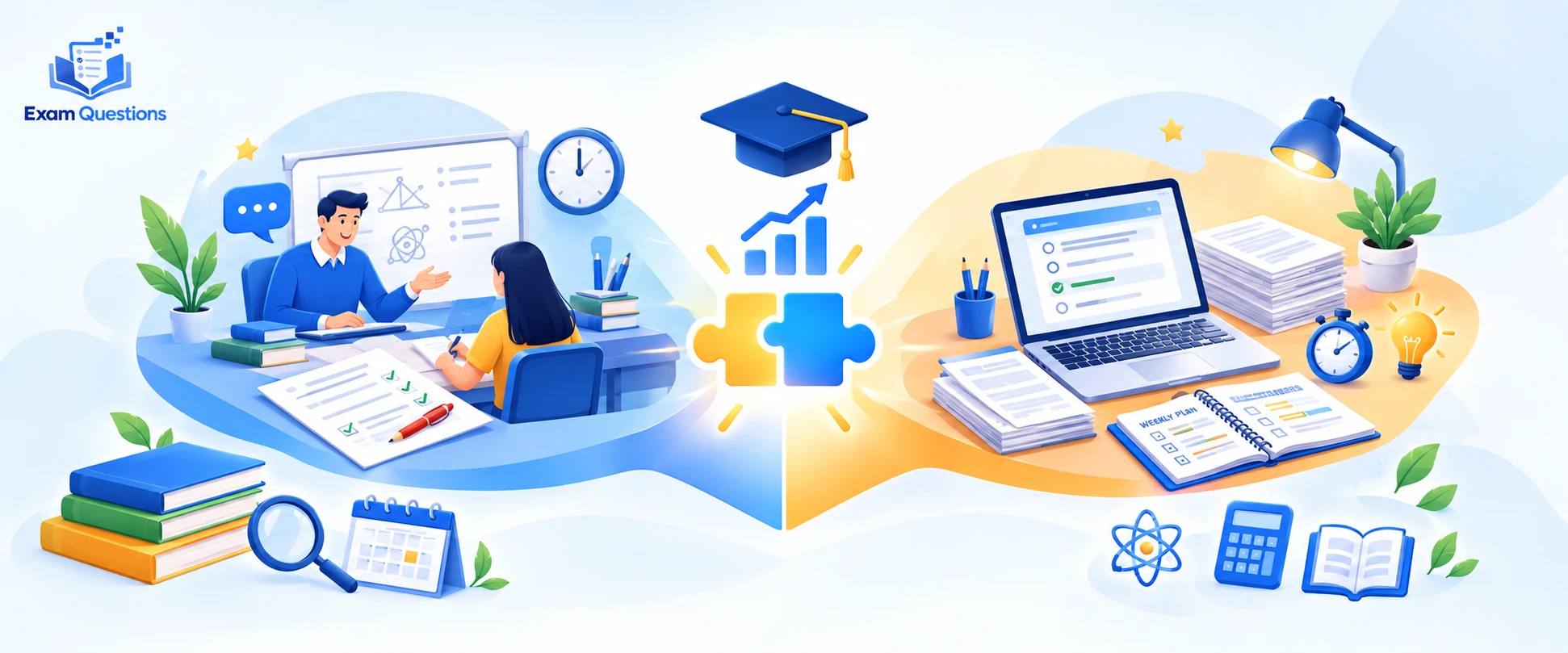
Sooner or later, most A Level students face the same choice. Do you book a tutor, or do you work through the material on your own? Friends will tell you opposite things with equal confidence. One swears that a tutor saved their grade, another says they never needed one. Both can be right, because the better question isn't which approach is best. It's which one fits you, in this subject, at this point in the course.
This guide helps you decide. It compares what each approach gives you, shows the signs that point one way or the other, and explains the middle route that many students end up using. If you've already decided on a tutor, our guide to finding the right A Level tutor covers what to look for, and our article on finding A Level tutors near you covers the search. For the local picture, see our guide to A Level tutors in Karachi.
Costs, availability and teaching styles vary a lot, so treat this as a way of thinking, not a verdict. If you're still working out which subject needs the help, our A Level subjects page is a useful starting point.
What Each Approach Actually Gives You
It helps to split the question into the things a student actually needs. Different approaches provide different ones.
| What you need | A tutor | Self-study |
|---|---|---|
| Explanation of hard ideas | Strong: someone can explain it in several ways until it clicks | Mixed: books, videos and notes help, but you can't ask them questions |
| Feedback on your work | Strong: a person reads your answers and tells you what to fix | Weak unless you mark carefully against mark schemes |
| Structure and accountability | Strong: fixed sessions and someone expecting your work | Depends entirely on your own discipline |
| Flexibility | Limited by the tutor's schedule and your travel | High: any time and any pace |
| Cost | Usually the largest extra cost | Low, mostly time and a few resources |
| Building independence | Can build it if used well, or reduce it if relied on | Strong: you learn to work things out |
What Self-Study Does Well
It builds independence. A Level and university both reward students who can work through material alone, so the habit pays off beyond the exams.
It fits your own pace. You can spend a long time on a hard topic and move quickly through one you already know.
It costs little. Past papers, the syllabus and topic questions are available without paying for lessons.
It forces you to find your gaps. Working alone, you quickly learn what you can and can't do without help.
What a Tutor Does Well
Explanations that fit you. A good tutor sees where you're stuck and tries a different angle, which a textbook can't do.
Real feedback. Someone reads your answers, spots the pattern in your mistakes and shows you how to earn the marks.
Exam technique. An experienced tutor knows how questions are worded and marked, and can teach you to write answers that score.
Accountability. A set session and someone expecting your work can keep you going when motivation dips.
Where Each One Falls Short
Neither approach is complete, and knowing the weaknesses helps you cover them.
Self-study falls short when you don't know what you don't know. Without feedback, it's easy to repeat the same error for months, to skip a topic you find hard or to believe you've understood something you haven't. It also relies on discipline, and that can wear thin in the middle of a long course.
Tutoring falls short when it replaces thinking instead of supporting it. A tutor who explains everything and sets nothing for you to try produces students who understand in the lesson and struggle alone. A poor match, or a tutor who doesn't know your syllabus, can also waste both money and time.
Questions That Point One Way or the Other
Answer these honestly. They won't give a verdict, but they show where you lean.
- When you get stuck, can you usually work out why from your notes or a textbook?
- Do you finish practice questions without being asked, or only when someone expects them?
- When you read a mark scheme, can you see why your answer lost marks?
- Are your marks rising, flat or falling despite your effort?
- Is the problem one subject or topic, or all your subjects?
- Do you have a clear weekly study routine that you keep?
Signs You Could Manage on Your Own
- You understand most lessons and mainly need practice.
- You keep a regular routine without reminders.
- You can use the mark scheme to see where you lost marks and fix it.
- Your marks are steady or improving.
- Your teachers are approachable and answer your questions.
If most of these describe you, a tutor may add little beyond what you're already doing. A little extra practice and a few well-chosen resources might be all you need.
Signs a Tutor Could Help
- You're stuck on a topic and explanations from notes and videos haven't helped.
- Your marks have stalled despite regular practice, and you can't see why.
- You understand the content but lose marks on technique and wording.
- You struggle to start or keep going without someone expecting your work.
- Your school's support has gaps in a particular subject.
If a few of these ring true, targeted help is worth considering. And the word "targeted" matters, because a tutor is most useful when they're aimed at a specific problem.
The Middle Route: Using a Tutor for Part of the Work
The choice isn't all or nothing. Many students use a hybrid approach, and it often gives the best value.
A short block for a specific topic. A few sessions to clear up a stubborn topic, then back to self-study.
Exam-technique sessions before the exams. A tutor who marks timed answers and shows how to earn marks, in the last few months.
A marking and feedback arrangement. You do the work alone and send it for review, instead of paying for full lessons.
One tutor for the hardest subject only. Self-study in the others, with help concentrated where it's needed most.
This keeps most of the independence and cost advantages of self-study, while giving you human feedback where it matters.
How to Self-Study Well
Self-study only works if it's structured. Reading notes and hoping isn't a plan.
- 1
Start from the syllabus. It tells you exactly what's examined. Use our syllabus pages and topic pages as a checklist.
- 2
Plan short, regular sessions. Little and often beats occasional marathons.
- 3
Practise from the start. Use our A Level practice and A Level questions pages instead of only re-reading notes.
- 4
Use past papers for real feedback. Mark them carefully with the mark scheme. Our past papers pages give you real exam questions.
- 5
Keep an error log. Write down each mistake and how to fix it, and review it weekly.
How to Use a Tutor Without Depending on One
- Bring work you've already tried. Lessons are best spent on what you couldn't do, not on starting from nothing.
- Set a clear goal. For example, "Understand electrochemistry" or "Write better evaluation answers."
- Ask for tasks between sessions. Learning happens when you practise, not only when you listen.
- Review progress every few weeks. Ask what's improved and what still needs work.
- Plan an end point. A good tutor works towards your independence.
Our guide to A Level tutors explains how to tell whether lessons are working, and when it's time to stop.
Two Imagined Students, Two Different Answers
Maryam, steady but stuck on one topic. She keeps a routine, practises regularly and her marks are good, except in organic chemistry, where nothing seems to stick. A short block of sessions on that one topic, with a tutor who can explain it from a new angle, is likely to be enough. The rest of her study stays independent.
Bilal, willing but unfocused. He understands the lessons but rarely practises unless someone expects it, and his marks have drifted down. A tutor's value for him is mostly structure and accountability, so he needs fixed sessions and set tasks between them, along with a simple weekly plan he can follow himself.
Notice that neither case is "needs a tutor" or "doesn't need a tutor" in general. The question for each is what exactly is missing, and which approach supplies it at the lowest cost in time and money.
Where Help Tends to Matter Most
It varies by student, but a few patterns come up often.
- Maths and the sciences. Stuck points can block later topics, so a tutor can help where explanations aren't landing. Regular problem practice does much of the rest.
- Essay-based subjects. Feedback on structure and evaluation is hard to get alone, so a marking arrangement can be valuable.
- Computer Science and Accounting. Practice and checking matter most, and a tutor can speed up finding errors.
Common Worries About Each Approach
"If I don't hire a tutor, I'll fall behind." Not necessarily. Many students do well with structured self-study and good use of their teachers. Falling behind comes from missing practice and feedback, not from the lack of a tutor.
"If I hire a tutor, it means I'm weak." It doesn't. Strong students often use a tutor for a particular goal, such as sharpening exam technique, in the same way an athlete uses a coach.
"Self-study means doing everything alone." It doesn't have to. You can still ask your teachers, work with friends and use online practice, which gives you support without paying for lessons.
"A tutor guarantees better grades." No tutor can promise a result. Lessons help when they're matched to a need and supported by your own practice.
Cost and Time Compared
We won't quote figures, because they vary so much between tutors, subjects and cities. In general, self-study costs mostly time, while tutoring adds fees and, often, travel.
Think about total effort as well as money. A tutor doesn't remove the need to practise, and a student who attends lessons but doesn't do the work gains little. Ask what you'd do with the lesson hours if you didn't have them, and whether you'd use them well.
A Note for Students in Karachi
In a city with long commutes and busy evenings, the practical side matters. A tutor you can't reach reliably is worth less than a plan you can keep, and good evening slots fill early, especially around exams.
If you decide a tutor would help, our guide to A Level tutors in Karachi covers formats, availability and how to check subject specialisation. If you decide to go it alone, make sure you've built in a way to get feedback, such as a teacher, a study group or a marking arrangement.
A Four-Week Experiment
If you're unsure, test it. A short trial gives you evidence instead of guesses.
- 1
Week 1: Baseline. Do a timed section from a past paper, mark it and note your weak topics.
- 2
Weeks 2 and 3: Self-study with structure. Follow a plan based on the weak topics, with practice and an error log.
- 3
Week 4: Re-test. Do a similar section and compare. Did your marks improve? Did the same mistakes recur?
- 4
Decide. If you improved, carry on. If you're stuck on the same issues, you now know exactly what to ask a tutor to help with.
Students, Parents and Who Decides
Parents often feel a tutor is a safe choice, while students may feel it's unnecessary or the other way round. A calmer approach is to look at evidence together: recent marks, the four-week experiment and what the student feels is missing.
Treat it as a shared decision. A tutor the student doesn't want rarely works, and a student refusing help when they're clearly stuck is a problem worth discussing openly.
How to Tell Whether Your Choice Is Working
Whichever route you pick, check it after a few weeks instead of assuming it's fine. The evidence is usually easy to find.
- Are your practice marks improving, especially on the topics you were weak in?
- Are you making new mistakes instead of repeating the old ones?
- Do you feel more confident when you open a past paper?
- Are you keeping up with your routine without it feeling like a struggle?
If the answers are mostly yes, carry on. If they're mostly no, change something: the plan, the amount of feedback or the kind of help. A choice you review regularly is much more likely to serve you than one you made once and never looked at again.
Mistakes to Avoid
- 1
Hiring a tutor by default. Everyone else has one isn't a reason. Check whether you need one.
- 2
Refusing help out of pride. Needing a tutor isn't a failure, and getting help early saves time.
- 3
Expecting a tutor to do the work. The lessons only help if you practise between them.
- 4
Skipping feedback in self-study. Practising without marking is a quiet way to repeat mistakes.
- 5
Deciding once and never revisiting. Your needs change across the course, so review your choice each term.
Questions to Ask Yourself Before Booking Anyone
- What exactly am I stuck on, and have I tried to fix it myself?
- What would I want from a tutor that I can't get from my teacher or my own practice?
- Can I commit to the sessions and the work in between?
- What would success look like in a month?
- Is a short block of sessions enough, or do I need ongoing support?
Where Online Tools Fit
Between tutors and pure self-study sits a growing set of online tools, from practice platforms to AI. Used well, they offer explanations and extra practice at any hour. The caution is the same as with a tutor: they should support your thinking, not replace it. Our AI exam preparation guide explains how to use AI as a study partner without letting it do the work.
Final Thoughts
Tutoring and self-study aren't rivals. They solve different problems. Self-study builds independence and costs little, a tutor adds explanation, feedback and structure, and together they can cover each other's gaps. The best choice depends on where you're stuck and what you're willing to do about it.
If you decide to look for a tutor, read our guide to finding the right A Level tutor, our article on finding A Level tutors near you and our guide to A Level tutors in Karachi. Together with this comparison, they take you from deciding to choosing to making the lessons count.
Practise the subjects you choose
Work through topic questions and past papers for your A Level subjects, and get your answers marked with the reasoning behind each mark.