Ask a group of A Level students what the best way to prepare is and most will say "past papers." Ask how they use them and the answers get vaguer. Some do a paper, glance at the score and start another. Others save them all for the final week and hope for the best. Neither approach gets much out of what is probably the most useful revision material available.
This guide is about the method: when to begin, how to attempt a paper, how to mark it properly, how to sort your mistakes into types and how to turn the result into the next week's work. It fits inside the wider plan in our guide on how to revise for A Level exams, and you can find real papers on our A Level past papers pages. For practice beyond full papers, see how to practise A Level exam questions, and for reading the marking guide itself, see how to use A Level mark schemes. For practice against the clock, see how to prepare for A Level exams under timed conditions. To compare real papers with generated questions, see AI-generated questions vs past papers.
Details differ between subjects and exam boards, and nothing here replaces advice from your teachers. Keep your current syllabus nearby, because a paper only helps if it matches what you are actually being examined on.
Why Past Papers Are So Useful
A past paper shows you three things that notes and textbooks can't. It shows how the examiner words a question, which is often different from how a textbook explains the idea. It shows how marks are split between recall, method and explanation. And it shows how it feels to work against a clock, which no amount of reading can reproduce.
There is also a more practical reason. Exam boards set questions in recognisable styles, and the same topics are examined in similar ways from year to year. After a few papers, you start to see the patterns: the command words that appear, the kinds of diagram you are asked to read and the sort of working that earns method marks. Seeing those patterns in advance makes the real paper feel familiar.
Where to Find Genuine Papers and Mark Schemes
Use real papers from the exam board wherever you can. For Cambridge International A Levels, the board publishes syllabuses, past papers, mark schemes and examiner reports on its official website, Cambridge International. Your school may also give you access to a teacher resource area with extra material.
- The question paper. Check that it is for the same syllabus code you are studying, since syllabuses are updated from time to time.
- The mark scheme. This is the official answer guide and shows exactly how marks are awarded.
- The examiner report. Where available, it explains common mistakes and what stronger answers did differently. It is often the most underused resource of all.
You can also browse papers by subject on our A Level past papers pages. Whatever source you use, make sure the paper and the mark scheme belong together and match your syllabus.
When to Start Using Past Papers
Many students believe papers are only for the end of the course. In practice, the earlier you use them in small pieces, the more useful they become, because you have time to act on what they show you.
| Stage | How to use papers | Why |
|---|---|---|
| Early in the course | Single questions on a topic you have just learned | Checks understanding while it is fresh |
| Middle of the course | Timed sections, a few questions at a time | Builds speed and shows weak topics |
| Approaching the exams | Full papers in exam conditions | Tests stamina, timing and technique |
| Final days | Re-working past mistakes, not new papers | Locks in the lessons you have already paid for |
One warning: papers are a limited supply. For each subject, there are only so many recent ones, and once you have done a paper, you cannot fully use it again as a fair test. Keep the most recent ones back for the later stages, and use older or topic-based questions earlier.
How to Attempt a Paper
How you sit the paper decides how useful the result is. A rushed attempt with your phone beside you tells you very little.
- 1
Choose the right paper. Pick one that matches your syllabus and your stage, and check it is complete.
- 2
Set up properly. A quiet desk, a clock, the equipment you will have in the exam and no notes.
- 3
Respect the time limit. Start the timer and stop when it ends. Use a different colour of pen if you want to keep going afterwards. Our guide on how to prepare for A Level exams under timed conditions covers pacing in detail.
- 4
Write full answers. Show your working and explain your reasoning as you would in the exam. Don't leave gaps because you plan to look them up.
- 5
Leave the answers alone. Don't check the mark scheme halfway through, however tempting it is.
Early in your preparation, you can relax some of these rules. Doing a section with notes open is a perfectly good way to learn a topic. Just be honest with yourself about which kind of attempt it was when you record the score.
How to Mark Your Work Properly
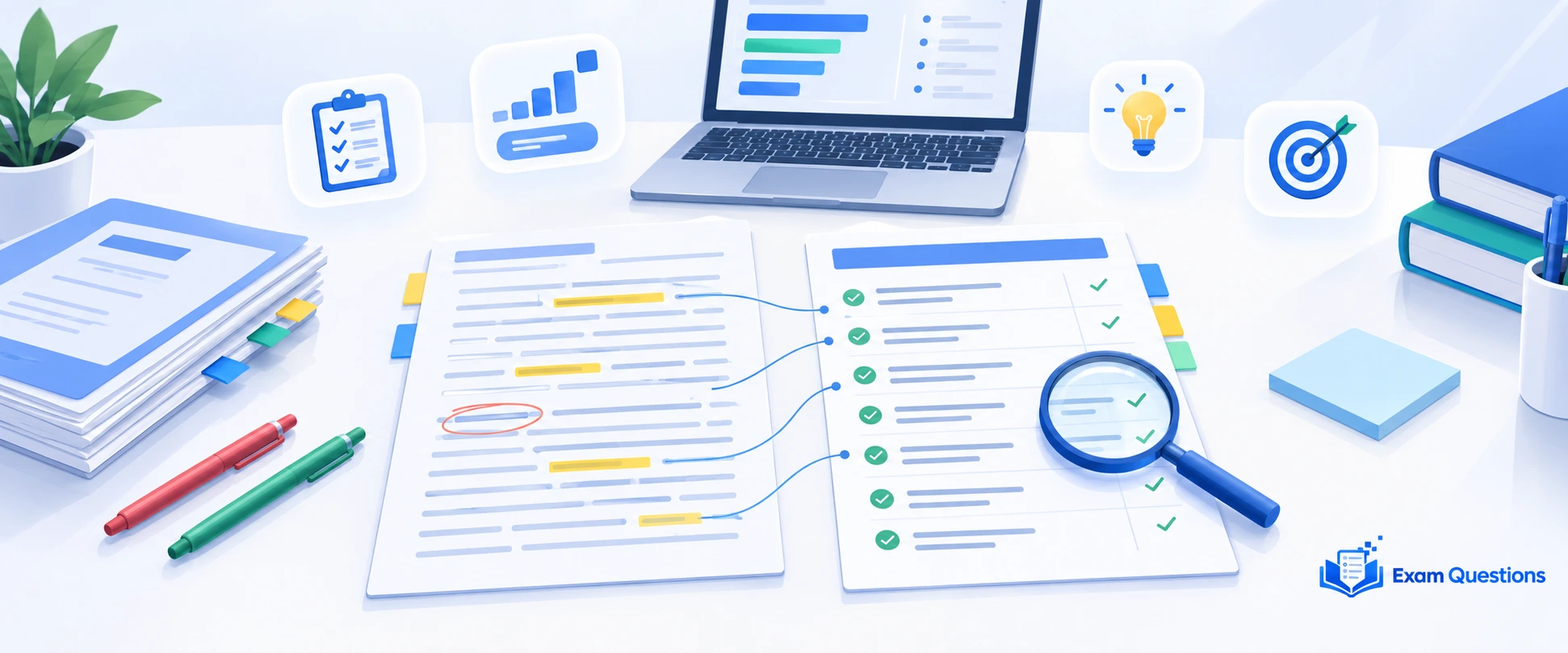
Marking is where most of the learning happens, and it is the step students are most likely to rush. A paper that has been attempted but not marked carefully is a wasted opportunity.
- 1
Use the official mark scheme. Not a classmate's answer, and not a general explanation.
- 2
Be strict. If the scheme asks for a specific term or step and you didn't write it, you don't get the mark, even if you "basically knew it."
- 3
Read the alternatives. Mark schemes often list acceptable answers and words that are not accepted. Learn the difference. Our guide on how to use A Level mark schemes explains how to read them.
- 4
Mark in a different colour. It keeps your original work visible and shows where the gaps were.
- 5
Record the score. Note the date, paper and total, plus the marks lost in each section.
Being strict can feel harsh, but the examiner will be. A lenient self-mark gives you false confidence, and false confidence is far more costly in the exam hall than a low score is in practice.
Sorting Your Mistakes Into Types
The real work starts when you look at the marks you lost and ask why. "I got it wrong" is not an answer. Different kinds of error need different fixes, and sorting them is what turns a score into a plan.
| Type of mistake | What it looks like | What helps |
|---|---|---|
| Knowledge gap | You didn't know the fact, definition or idea | Learn it again, then test yourself on it a few days later |
| Method error | You knew the topic but used the wrong approach | Redo the question and study a worked example |
| Careless slip | A sign error, a missing unit, a copied figure wrong | Slow down and build a short checking routine |
| Misread question | You answered something other than what was asked | Underline command words and key terms before you write |
| Timing problem | You ran out of time or rushed the end | Practise timed sections and set a mark-per-minute guide |
| Weak explanation | The idea was right but the wording lost marks | Study mark schemes for the phrases that earn credit |
Write each lost mark in an error log with its type and the correct approach. After a few papers, the same categories keep appearing. That is useful information, because it tells you whether you need more knowledge, more careful reading or more speed. Our guide on how to practise A Level exam questions goes further into mistake types and follow-up questions.
Turning the Results Into a Plan
Once you know what went wrong, make the next few days about fixing it. Otherwise the paper was just a measurement, not a step forward.
- 1
Group the lost marks by topic. Which two or three topics cost you the most?
- 2
Relearn the topic. Use your notes or textbook, then close them and write down what you remember.
- 3
Practise it separately. Find more questions on exactly that topic and work through them.
- 4
Redo the original questions. A week later, try the ones you got wrong again, with the answers hidden.
- 5
Test it in a new paper. See whether the same mistake appears again or finally disappears.
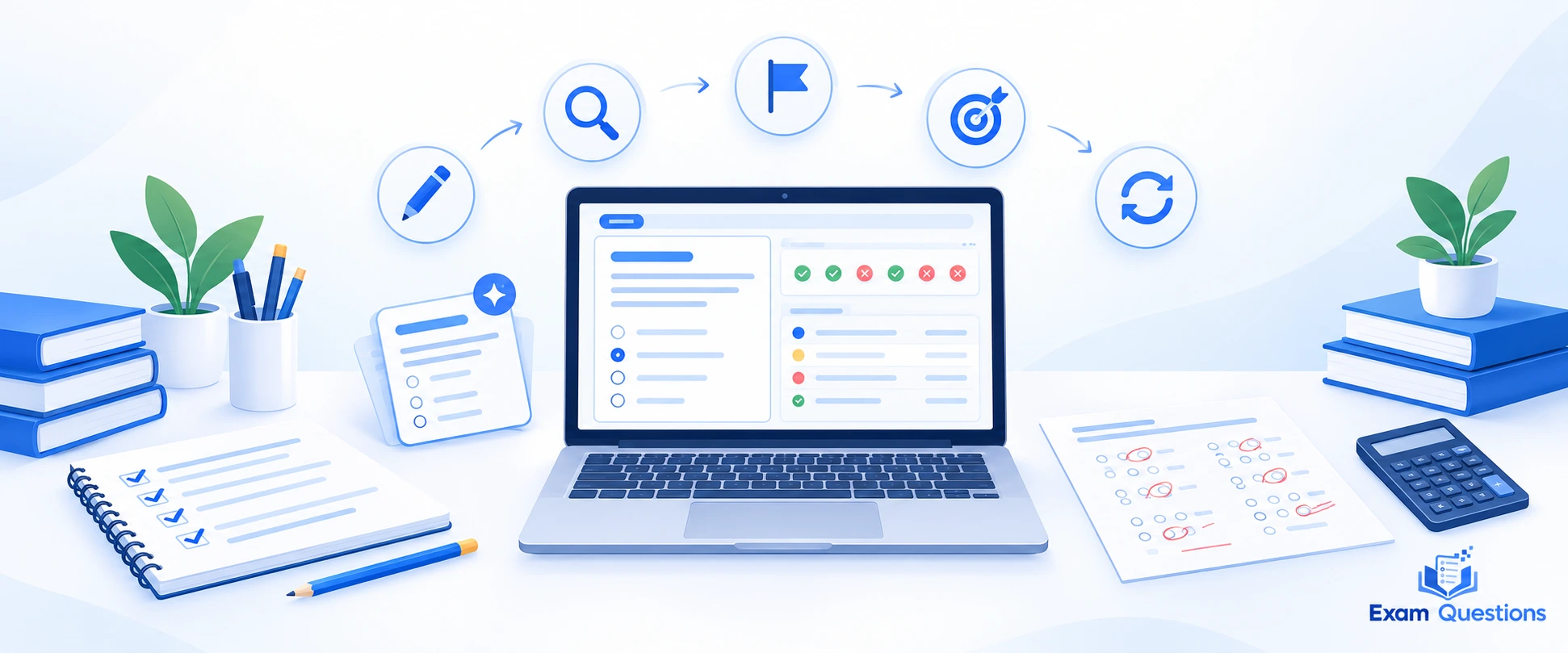
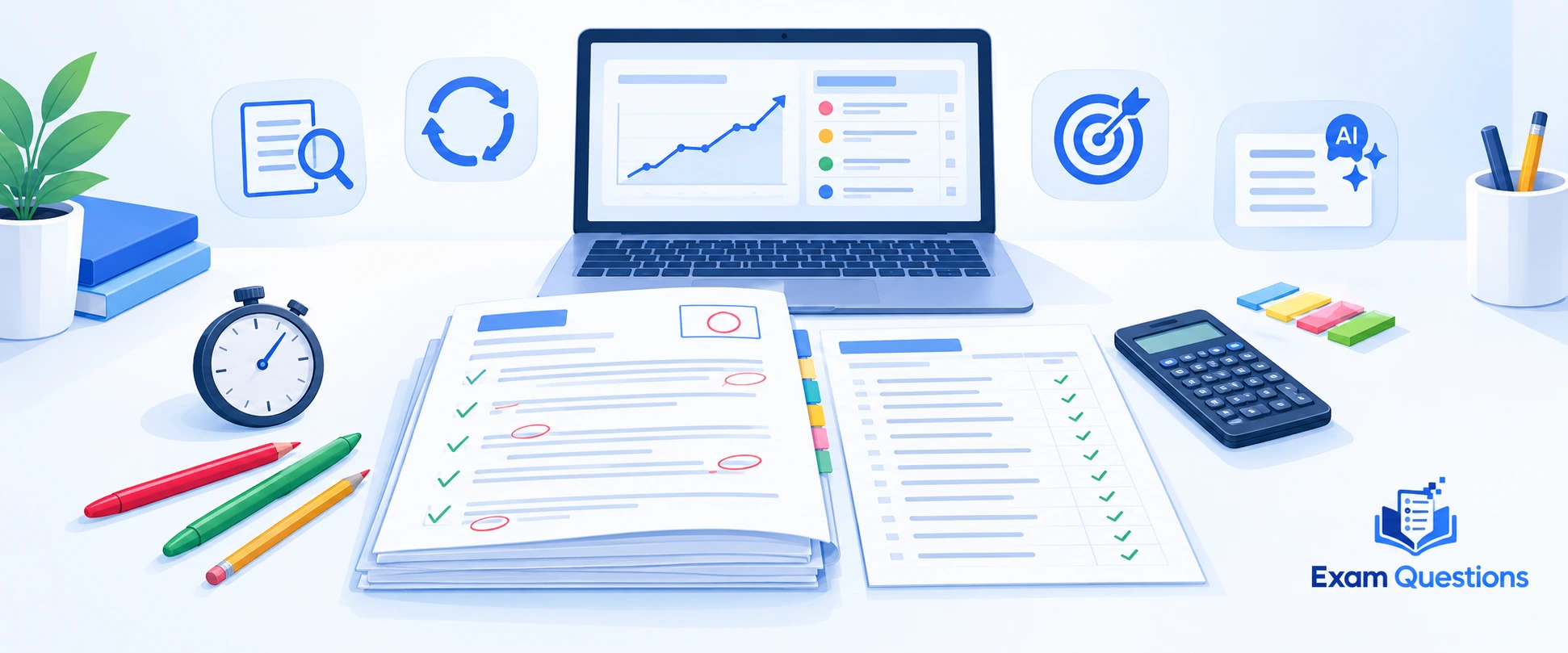
This loop of attempt, mark, categorise, fix and retest is the heart of good past-paper work. A student who does ten papers this way will usually improve more than one who rushes through thirty.
How Many Papers Should You Do?
There is no magic number, and it depends on the subject, the time you have and how much you take from each paper. A sensible rule is to favour depth over volume. One paper that you mark carefully, analyse and learn from beats three that you scribble through and forget.
If you are short of time, do fewer full papers and more targeted questions. Choose the topics that cost you marks, practise those, and sit a smaller number of full papers under proper conditions to check your timing.
A Quick Example of Reviewing One Paper
Imagine you score 58 out of 100 on a timed paper. The number alone isn't very helpful. Now imagine you go through the 42 lost marks and find that 15 came from two topics you hadn't revised properly, 12 came from misreading what the question asked, 9 came from running out of time on the last question and 6 were small slips in calculation.
That breakdown changes your week. Two topics need relearning, you need to underline command words before you start writing, you need to practise the end of the paper under a clock, and a short checking routine will pick up the small slips. You now have four specific jobs instead of a vague plan to "do better." That is what a well-reviewed paper gives you.
Where AI-Generated Questions Fit
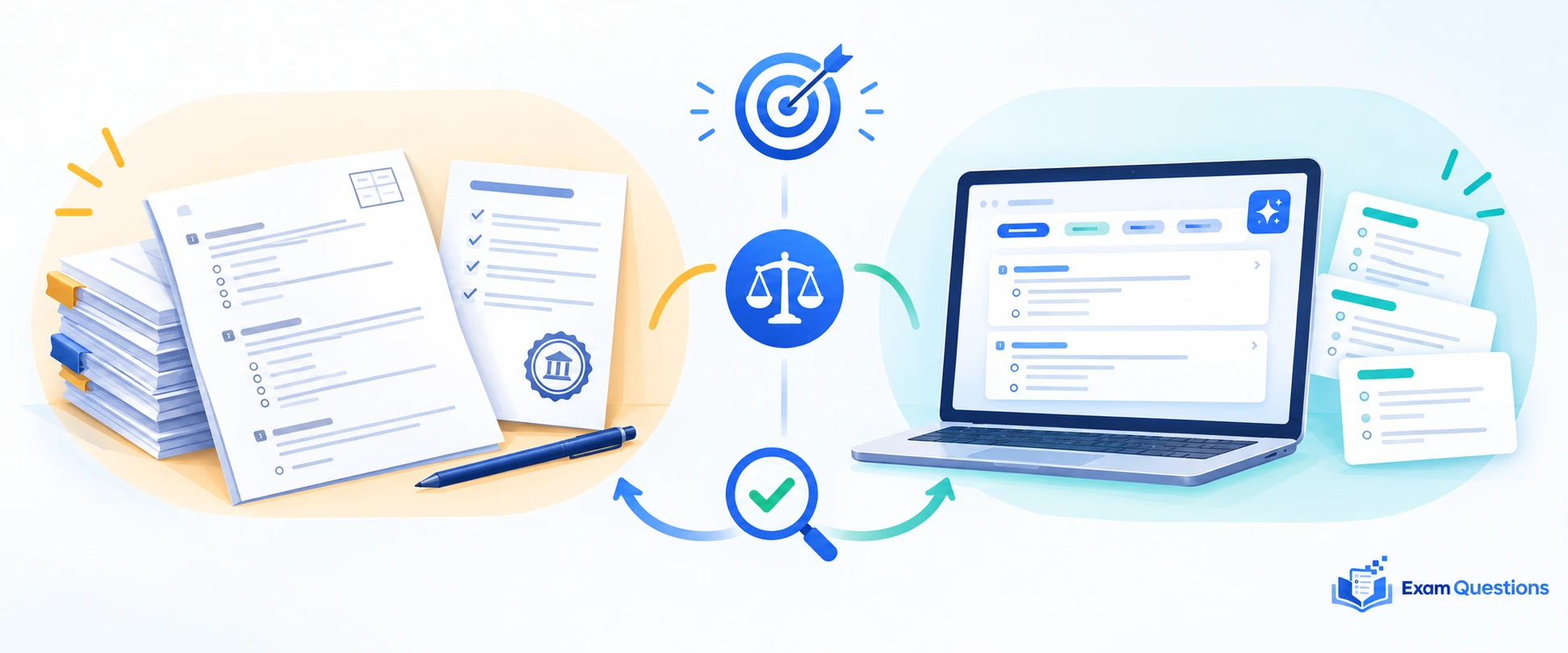
Past papers have one limit: there is a finite number of them. Once you have worked through the recent ones, you may want more practice on a specific topic, or a quick question when you have ten minutes. That is where AI-generated questions can help.
They complement papers; they don't replace them. A past paper is written and checked by the exam board and shows you the real standard. AI-generated questions are useful for extra volume, for targeting a weak topic or for practising a type of question again, but they can contain mistakes and don't always match the style of the real exam. Treat them as extra practice, and check anything important against the syllabus and the official mark schemes. Our guide to AI-generated questions vs past papers compares the two in detail.
- Use real papers to measure your level and your timing.
- Use generated questions to drill a specific topic after you have found it in your error log.
- Always attempt the question yourself before reading any feedback.
- Verify explanations against your textbook, teacher or the mark scheme when marks depend on them.
Our A Level practice pages and AI exam preparation guide explain how this kind of practice can sit alongside the real thing.
Common Past-Paper Mistakes
- Using up all the papers too early. You need a few fresh ones for the final weeks.
- Marking generously. Giving yourself marks you wouldn't get from an examiner hides the real picture.
- Looking at the answer too soon. Peeking when you're stuck turns practice into copying.
- Ignoring the examiner report. It tells you what examiners actually saw go wrong.
- Only doing papers you expect to do well on. Comfort doesn't build skill.
- Skipping the follow-up. A score with no analysis rarely changes the next one.
Using Papers in the Final Weeks
In the last few weeks, the emphasis shifts to performance. Sit full papers at the same time of day as your real exams, keep to the exact time limit, and mark them straight afterwards while the paper is fresh.
In the last few days, avoid starting a brand-new paper that might shake your confidence. Go back through the errors you have already logged and make sure those specific points are secure. A calm review of known weaknesses is worth more than one more score.
Final Thoughts
Past papers are powerful because they are real, but they only change your grades if you treat them as a feedback tool. Attempt them honestly, mark them strictly, sort your mistakes, fix the weak topics and test yourself again.
Start small, build up to full papers and keep a record of what you learn from each one. For how past papers fit into a whole revision plan, read our guide on how to revise for A Level exams, and browse real papers on our A Level past papers pages whenever you are ready for the next one.
Practise the subjects you choose
Work through topic questions and past papers for your A Level subjects, and get your answers marked with the reasoning behind each mark.