
Every year, students walk out of exams sure they "basically got it" and then lose marks for reasons they never saw coming. The answer was nearly right, but the key term was missing. The working was correct, but the final line didn't answer the question. The explanation was long, but it never reached the point the examiner was looking for.
Most of these losses are predictable, and the best place to learn them is the mark scheme. This guide explains what mark schemes are, how to read them, what command words and different kinds of marks mean, and how to turn what you find into better answers. It builds on our wider guide on how to revise for A Level exams, and works hand in hand with our advice on using A Level past papers and practising exam questions. For time pressure, see how to prepare for A Level exams under timed conditions, and for how generated questions differ from official ones, see AI-generated questions vs past papers.
Mark schemes differ between subjects, papers and exam boards, and they change over time, so treat the examples here as illustrations rather than rules. Always check the scheme and syllabus for your own course.
What a Mark Scheme Is
A mark scheme is the guide examiners use to mark a paper. It lists the acceptable answers, the points that earn credit and, in many cases, the ways of writing an answer that are not accepted. Its job is consistency: two examiners reading the same answer should award the same marks.
For a student, that makes it an unusually honest document. It doesn't say what ought to be a good answer. It says what actually gets marks. Reading it closely shows how the exam board thinks, which is hard to learn from a textbook.
Where to Find Genuine Mark Schemes
Use the official scheme for the exact paper you attempted. For Cambridge International A Levels, the exam board publishes past papers, mark schemes, syllabuses and examiner reports on its official website, Cambridge International. Your school may also provide extra material.
- Match the scheme to the paper: the same syllabus code, session and paper number.
- Read the general notes at the start. They usually explain the abbreviations and conventions the scheme uses.
- Where available, read the examiner report as well. It describes how candidates actually answered and what went wrong.
You can browse papers by subject on our A Level past papers pages, then pair each one with its mark scheme before you start marking.
Command Words: What the Question Is Really Asking
Many lost marks come from answering a different question from the one asked. The command word, the verb at the start of the question, tells you the kind of answer required. Exam boards usually publish a list of command words and their meanings in the syllabus, so look at yours.
| Command word | Usually means | Typical mistake |
|---|---|---|
| State | Give a short, direct answer without explanation | Writing a paragraph when one line is enough |
| Describe | Say what something is like or how it changes | Explaining why instead of describing what |
| Explain | Give reasons, linking cause to effect | Listing facts without linking them |
| Calculate | Work out a numerical answer, showing the method | Giving only the final number, or the wrong unit |
| Compare | Point out similarities and differences | Describing each thing separately without linking them |
| Evaluate or discuss | Weigh up evidence and reach a judgement | Making points but never concluding |
These meanings are general. The precise definition can vary by subject, so use the list published for your own syllabus. Before you write, underline the command word and circle the key terms in the question, then check your answer against both.
Let the Number of Marks Guide You
The marks shown beside a question are a clue to how much to write. A two-mark question usually wants two distinct points, not a paragraph. A six-mark question is expecting a developed answer with several linked points.
- One point per mark. As a rough guide, a two-mark question often needs two separate things said clearly.
- Don't repeat yourself. Saying the same point in different words rarely earns a second mark.
- Don't run out of time. If you spend ten minutes on a three-mark question, something else will suffer.
Comparing the marks available with the points listed in the scheme shows you quickly how much detail the examiners wanted. Our guide on how to prepare for A Level exams under timed conditions shows how to turn marks into minutes.
Marking Points and How to Spot Them
In many subjects, the scheme breaks an answer into marking points, which are the individual ideas that earn a mark each. When you read a scheme, treat each point as a checklist item for your own answer.
- 1
Find the points. List what the scheme says earns each mark.
- 2
Tick what you wrote. Mark each point you included in your answer.
- 3
Note the wording. Check whether a specific term was required, and whether your wording was an accepted alternative.
- 4
Spot the gaps. See which points you missed and why: not known, not remembered, or not linked.
Over several questions, you'll see patterns. You might consistently give the idea but not the key term, or give the cause but not the effect. That tells you exactly what to practise.
Method Marks, Accuracy Marks and Following Through
In calculation-based subjects, marks are often split between the method and the answer. The details vary by subject and board, so check the notes at the start of your scheme, but the general idea is common.
| Idea | What it generally means | What it means for you |
|---|---|---|
| Method mark | Credit for using a valid approach, even if the answer is wrong | Show your working. A wrong final number can still earn some marks |
| Accuracy mark | Credit for a correct result, usually depending on the method being right | A right answer from the wrong method may not score |
| Independent mark | Credit for a correct statement or value that stands alone | Include key results and statements clearly |
| Follow-through | Credit for correct working based on an earlier error | A first mistake does not always lose every later mark |
The practical lesson is simple: write your working down, label your steps and don't cross out a method unless you replace it. A clear line of reasoning gives the examiner something to credit, even when the final answer slips.
What Different Subjects Expect
Mark schemes reflect the subject, so what earns marks in one may not in another. These are broad illustrations rather than rules.
- Maths and physics. Marks usually reward a clear method, correct use of formulae, units and a justified final answer.
- Chemistry and biology. Marks often reward precise terminology, linking cause to effect and accurate use of data.
- Essay-based subjects. Marks tend to reward a structured argument, relevant evidence and a reasoned conclusion, often judged against levels of response.
- Business and economics. Marks commonly reward application to the context given, analysis and evaluation, not only definitions.
The best way to learn what your own subject expects is to read several schemes for the same paper type and look for what the full-mark answers have in common.
Using a Mark Scheme to Improve Your Answers
Marking a paper is only useful if it changes what you do next. A simple process helps.
- 1
Mark honestly. Give only the marks the scheme would give, not the marks you feel you deserve.
- 2
Compare with a full-mark answer. See what the model answer includes that yours didn't.
- 3
Log the cause. Was it knowledge, method, wording, misreading or timing? Our guide on practising exam questions shows how to keep a mistake log.
- 4
Rewrite the answer. Redo the question using the scheme's structure, without copying it word for word.
- 5
Try a similar question. Test whether the improvement carries over.
Rewriting is the step students skip most often, and it is one of the most effective. It turns "I see what I should have written" into "I can now write it."
An Example of Reading a Scheme Closely
Imagine a three-mark question that begins with the command word "explain." Your answer is a confident, fluent paragraph, but you score one mark. When you open the scheme, you find three marking points: the cause, the process that follows from it and the result. You wrote the cause well, mentioned the result in passing and never described the process that links them.
The lesson isn't "write more." It's that "explain" asked for a chain, and your answer was missing a link. The fix is to practise writing short chains: this happens, which leads to this, so that happens. Once you've seen that pattern in one scheme, you start to see it in others, and your answers begin to line up with what examiners are looking for.
When Marks Are Awarded by Level
In longer, essay-style questions, schemes often don't list one mark per point. Instead, they describe levels of response, with a band of marks for answers that show a certain quality of knowledge, analysis or judgement. The examiner reads your whole answer and decides which description fits best.
- Read the level descriptors. They tell you what separates a basic answer from a developed one.
- Aim at the top level. Check your answer against the highest description and see what's missing.
- Plan before you write. A short outline helps you cover the points and reach a clear conclusion.
Practise by marking your own long answers against the descriptors, and then ask a teacher to look at one or two. Judging level-based answers is harder than ticking points, so outside feedback is especially valuable here.
Official Mark Schemes and AI Feedback Are Different Things
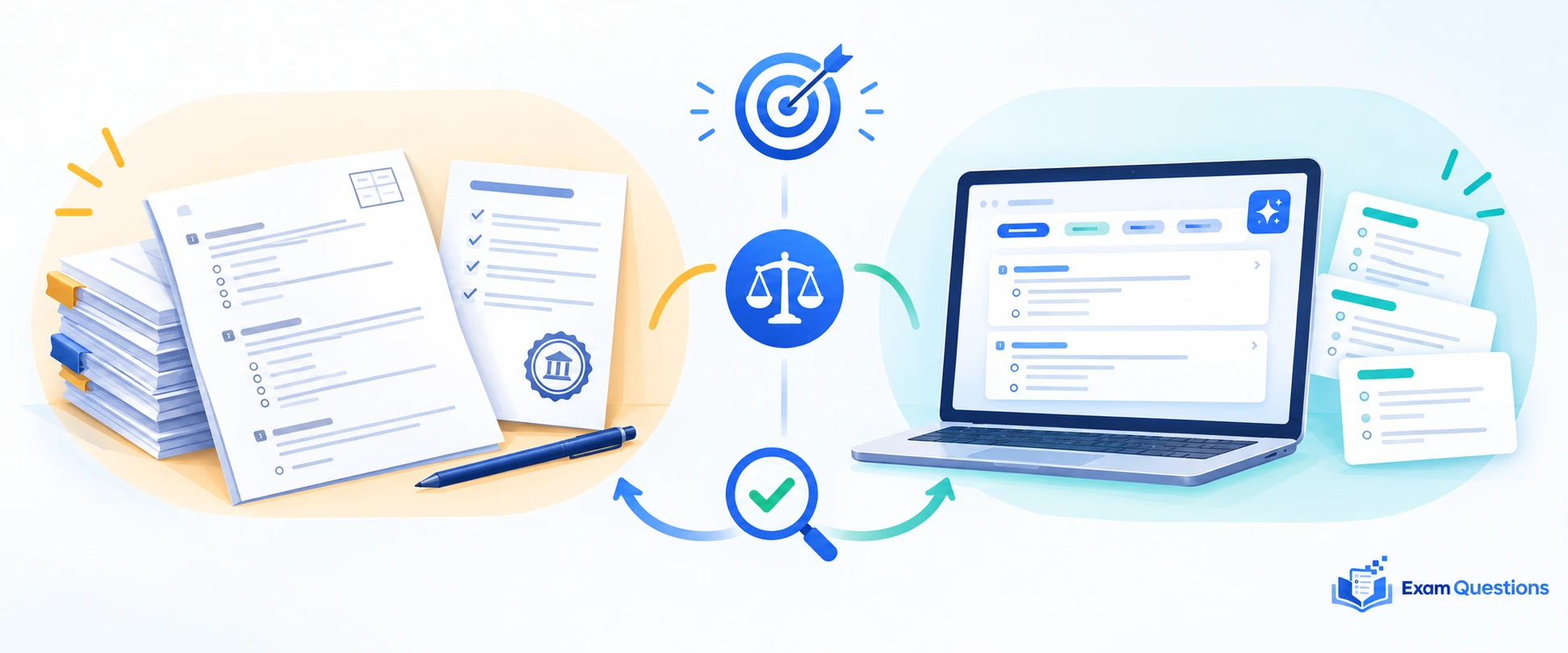
AI tools can now comment on your answers, and that can be genuinely helpful for thinking through what you wrote. But it is important to be clear about what that feedback is. It is not an examiner's mark, and it doesn't come from the exam board's mark scheme unless you check it against one.
- Official mark scheme. Written for the specific paper, used by examiners, and the standard against which your real answer is judged.
- AI feedback. A general response that may be helpful, but can be too generous, too harsh or simply wrong about what the exam board wants.
A sensible approach is to attempt the question yourself, mark it with the official scheme where one exists, and use AI afterwards to help you understand a point or practise similar questions. If AI feedback and the mark scheme disagree, trust the mark scheme. Our AI exam preparation guide explains how to use these tools without leaning on them for marking, and AI-generated questions vs past papers compares them with real papers.
Common Mistakes When Using Mark Schemes
- Reading the scheme before attempting the question. It turns practice into copying.
- Marking too kindly. "I knew that" does not earn the mark if the point isn't on the page.
- Memorising model answers word for word. Questions change, so learn the ideas and the structure.
- Ignoring the notes at the start. They explain the conventions the scheme uses.
- Skipping the examiner report. It shows how real candidates lost marks.
- Assuming one scheme fits every paper. Each paper has its own scheme and its own expectations.
A Note of Caution
Understanding mark schemes helps you answer more precisely, but it doesn't guarantee a particular grade. Results depend on knowledge, understanding, practice and what happens on the day. Treat mark schemes as a tool for learning how answers are judged, and rely on your teachers and the exam board for official rules about assessment and grading.
Final Thoughts
A mark scheme is the clearest explanation you'll ever get of how your answers are judged. Read the command word, note the marks available, look for the marking points, show your working and compare your work honestly with the official scheme. Then rewrite what went wrong.
For the whole plan this belongs to, see our guide on how to revise for A Level exams. Then pair this with how to use A Level past papers and how to practise A Level exam questions to put what you learn into action.
Practise the subjects you choose
Work through topic questions and past papers for your A Level subjects, and get your answers marked with the reasoning behind each mark.