Not long ago, the answer to "where do I get practice questions?" was simple: past papers, a textbook and whatever your teacher handed out. Now there is another option. You can ask an AI tool for ten questions on a single topic and have them in seconds. That raises an obvious question for anyone revising: if I can generate questions on demand, do I still need past papers?
The honest answer is that they do different jobs. This guide compares the two fairly, explains where each is strong and weak, and shows how to combine them so your practice is both realistic and plentiful. It sits within our wider guide on how to revise for A Level exams, and builds on our advice on using A Level past papers and practising exam questions.
One point up front: AI-generated questions are not official examination questions, and they are not predictions of what will appear. They are practice material, and their quality depends on the tool and on how you check them. Keep your current syllabus beside you as the reference for what you are actually examined on.
What Official Past Papers Give You
Past papers are written and checked by the exam board for real candidates. That gives them qualities no other source can fully match.
- The real standard. You see the actual level of difficulty and the way questions are worded.
- The real structure. Mark totals, section order, paper length and question styles are exactly as they were.
- An official mark scheme. You can check your answers against the guide examiners use. Our guide on how to use A Level mark schemes shows how to read one.
- Examiner reports. Where available, they explain how candidates actually performed.
For Cambridge International A Levels, the exam board publishes papers, mark schemes and syllabuses on its official website, Cambridge International, and you can browse papers by subject on our A Level past papers pages.
The limits of past papers
- They run out. Only so many recent papers exist for each subject, and once you've done one, it's no longer a fair test.
- They're broad. A full paper covers many topics, so you may get only a couple of questions on the one you're weakest in.
- Syllabus changes. An older paper may include content that has changed, so always check against your current syllabus.
What AI-Generated Questions Give You
AI tools can produce questions on request: on one topic, at a chosen difficulty, in a particular style. That flexibility is their real strength.
- Unlimited volume. You can keep practising a topic after the available papers have been used up.
- Targeted practice. Ask for questions on exactly the topic or skill your mistake log points to.
- Instant feedback. You can ask for an explanation straight away, which is useful when no one is around to ask.
- Flexible length. Ten minutes before dinner is enough for a short set.
The limits of AI-generated questions
- Not official. They are not set by the exam board, and they don't predict what will be asked.
- Can be wrong. A question may be poorly worded, have a flawed answer or contain an error in the explanation.
- May not match the exam. The style, difficulty and mark allocation can differ from real papers.
- Feedback can mislead. An AI's comments on your answer may be too generous or miss what the mark scheme wants.
None of these is a reason to avoid AI questions. They are reasons to use them knowingly and to check what matters.
A Side-by-Side Comparison
| Feature | Official past papers | AI-generated questions |
|---|---|---|
| Source | Set and checked by the exam board | Produced by a tool, not official |
| Matches the real exam | Yes, closely | Varies; may differ in style and difficulty |
| Supply | Limited number per subject | Effectively unlimited |
| Topic targeting | Mixed across the paper | Can focus on one topic or skill |
| Marking | Official mark scheme | Needs checking; not official marking |
| Best for | Measuring level, timing and technique | Extra practice and drilling weak topics |
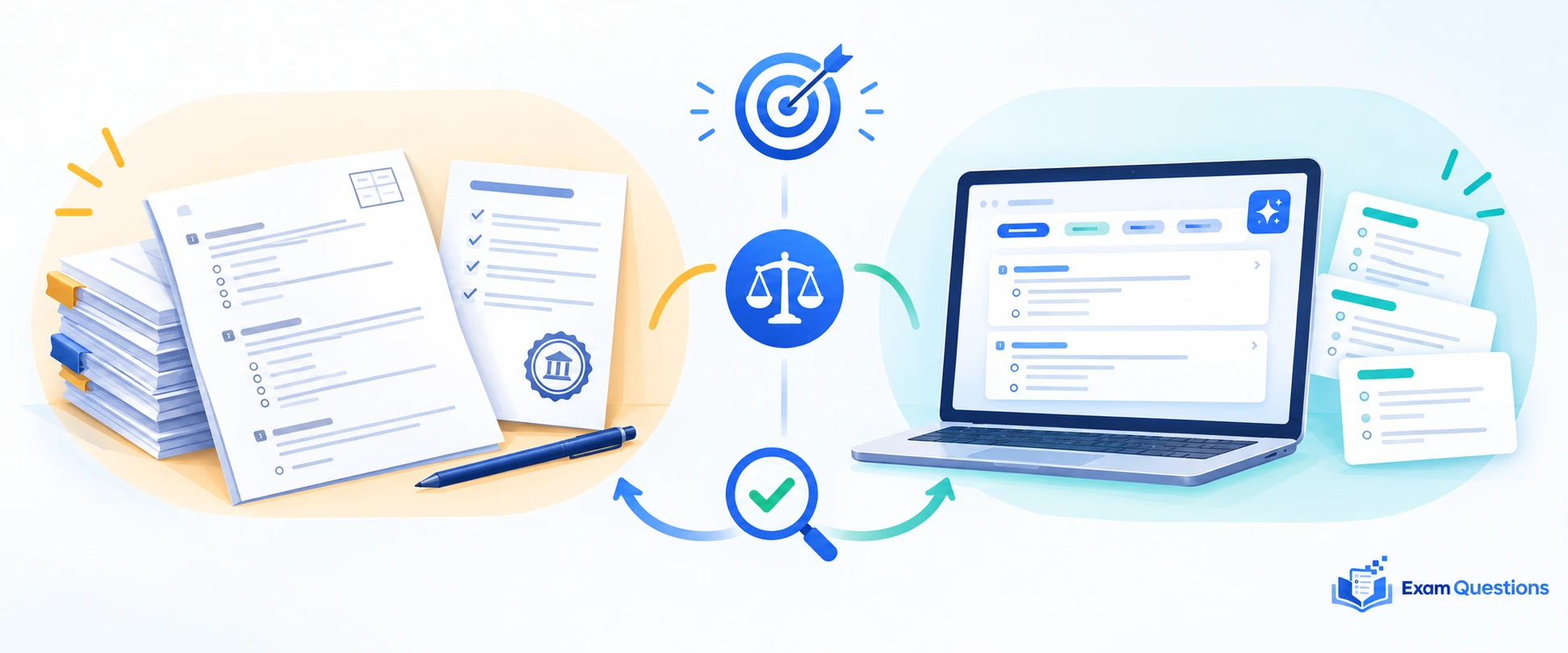
Seen this way, the question "which is better?" is a bit like asking whether a mirror or a gym is better for fitness. One shows you where you stand. The other lets you do more repetitions. You want both.
When to Use Official Papers
- To find out your true level and which topics need work.
- For timed sections and full papers in the later stages. Our guide on timed exam practice explains how.
- To learn how marks are awarded using the official mark scheme.
- For final checks in the weeks before the exam.
When to Use AI-Generated Questions
- To drill a weak topic after your mistake log has shown you where the problem is.
- When you have used up the recent papers but still need practice.
- For short sessions when a full paper would be too much.
- To practise a skill in different forms, such as the same method in new contexts.
A useful rule: let official papers decide what to work on, and let generated questions supply the extra practice on it.
How to Combine Them in Practice
- 1
Sit an official section or paper. Do it under the right conditions and mark it with the official scheme.
- 2
Log your mistakes. Sort them by type and topic, as described in our guide on practising A Level exam questions.
- 3
Generate targeted practice. Ask for several questions on the weakest topic and attempt them without help.
- 4
Check what matters. Verify answers and explanations against your textbook, teacher or mark scheme.
- 5
Retest with a real question. Return to a past-paper question on that topic to see if the improvement carries over.
This keeps real papers as your measuring stick, and uses generated questions as the training between measurements.
How to Get Useful Practice From an AI Tool
The quality of generated questions depends a lot on the request. Vague prompts get vague questions, so be specific.
- Name the subject, the exam level and the exact topic.
- State the type of question you want, such as short answer, calculation or extended response.
- Ask for the number of marks to be shown, so you can judge the depth expected.
- Request the answers only after you have attempted the questions.
- Ask it to follow the style of your syllabus, then compare the result with a real paper.
Our A Level practice pages and AI exam preparation guide explain how question-generation tools can fit into revision, and our A Level questions pages let you try questions by subject.
Why You Must Check AI Questions and Answers
A generated question can look polished and still be flawed. It may ask something the syllabus doesn't cover, give a model answer with an error or award marks in a way no examiner would. If you trust it blindly, you could practise a mistake until it feels right.
- Check the topic. Is the question inside your syllabus?
- Check the answer. Compare it with your textbook, notes or teacher.
- Check the marking. Does the mark allocation look similar to real papers?
- Look for odd wording. Unclear or unusual phrasing may be a sign of a weak question.
- Ask your teacher. If something doesn't look right, your teacher can settle it quickly.
If a generated answer and the official mark scheme ever disagree, trust the mark scheme.
AI Questions Are Not Predictions
It is tempting to think a generated question is a hint about what will be on the paper. It isn't. Exam boards set their papers independently, and no tool can know what will be asked. A generated question on a topic simply means the topic is on the syllabus, which you already knew.
The safest approach is to revise the whole syllabus, prioritise by your own weaknesses and use practice material of any kind to build skill, not to guess the paper.
An Example: One Topic, Both Methods
Suppose you sit a past-paper section and lose most of your marks on questions about one topic, say rates of change or the causes of a historical event. The paper has shown you a weakness, but it contained only three questions on the topic. That isn't enough to practise with.
So you go back to your notes, relearn the topic, then ask a tool for ten short questions on exactly that area, at a similar level. You attempt them without help, check the answers against your textbook and teacher, and note the ones you still get wrong. A week later you try the original past-paper questions again. If you can now answer them, the cycle worked. If not, you know the problem isn't volume of practice, and you can ask your teacher for help with the idea itself.
Which Method Suits Which Situation?
| Your situation | Lean towards | Why |
|---|---|---|
| Early in the course, learning a new topic | Short topic questions, including generated ones | You need small, frequent checks, not full papers |
| Middle of the course, finding weak spots | Past-paper sections | They show where you really stand |
| Used up the recent papers | Generated questions, then older papers | You need volume without wasting fair tests |
| Final weeks before the exam | Full past papers under timed conditions | You need the real standard, length and marking |
| Short on time today | A small generated set on one topic | A full paper would not fit |
These are guides, not rules. What matters is that your practice has a purpose at every stage, and that you check the material you rely on.
A Note for Parents and Teachers
If a student tells you they are revising with AI-generated questions, it isn't necessarily a worry. What is worth asking is whether they are also using real papers, whether they check the answers and whether they are using the practice to find and fix weaknesses. A student who does those three things is using the tool well.
It's also worth reminding them that practice material of any kind is a means, not a promise. A generated question doesn't hint at what will appear in the exam, and a good score on one doesn't guarantee the same result in the real paper. The most useful thing an adult can do is encourage steady, honest practice and regular review.
Common Mistakes When Choosing Between Them
- Treating generated questions as official. They aren't, and they shouldn't set your sense of the standard.
- Using only past papers and running out. Plan ahead and keep some for the end.
- Using only AI questions. You miss the real style, structure and marking.
- Skipping the check. Unverified answers can teach you the wrong thing.
- Practising only comfortable topics. Both methods are most useful on your weak areas.
- Expecting guaranteed results. Practice improves skill but guarantees nothing about grades.
Final Thoughts
Official past papers and AI-generated questions aren't rivals. Past papers show you the real standard and how you measure up. Generated questions give you the volume and focus to improve on specific topics. Use papers to decide what to work on, generated questions to practise it, and always check what you rely on.
For the full plan, read our guide on how to revise for A Level exams, and pair this with how to use A Level past papers, how to practise A Level exam questions, how to use A Level mark schemes and timed exam practice.
Practise the subjects you choose
Work through topic questions and past papers for your A Level subjects, and get your answers marked with the reasoning behind each mark.