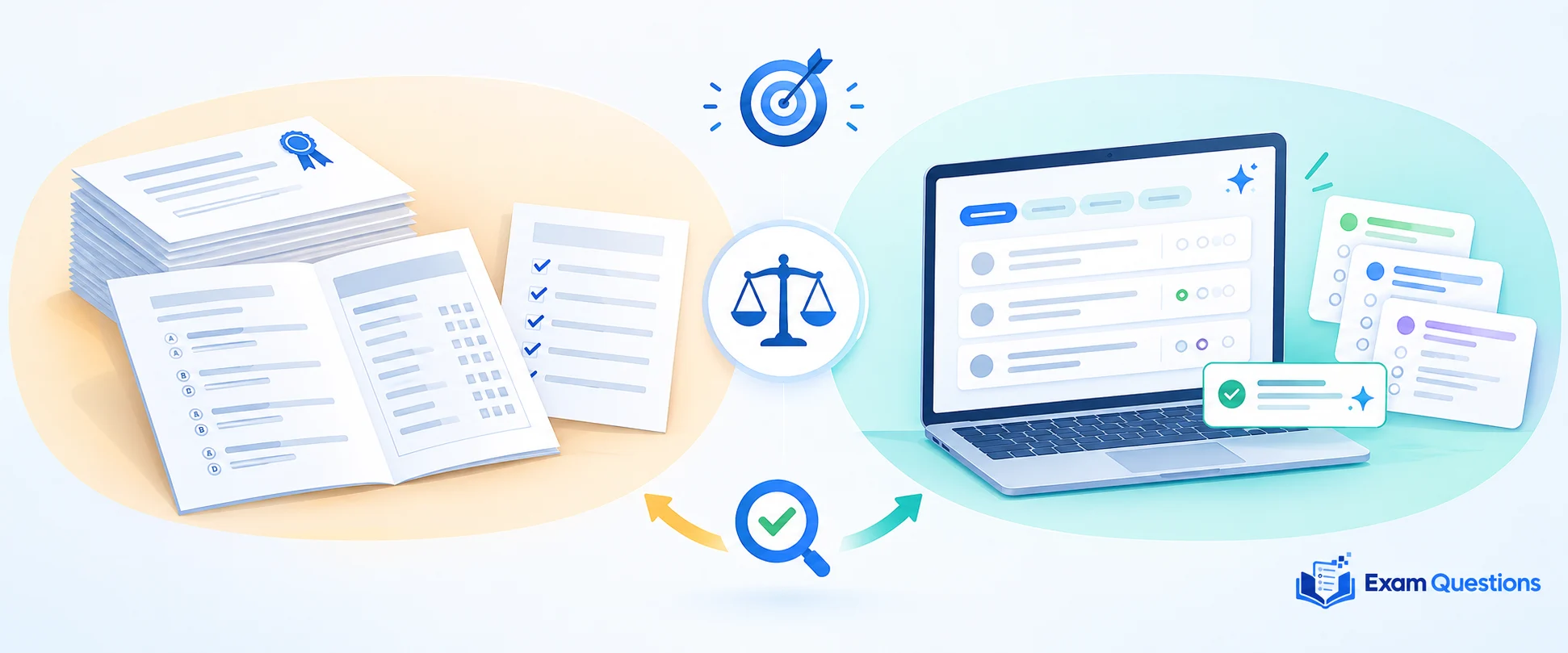
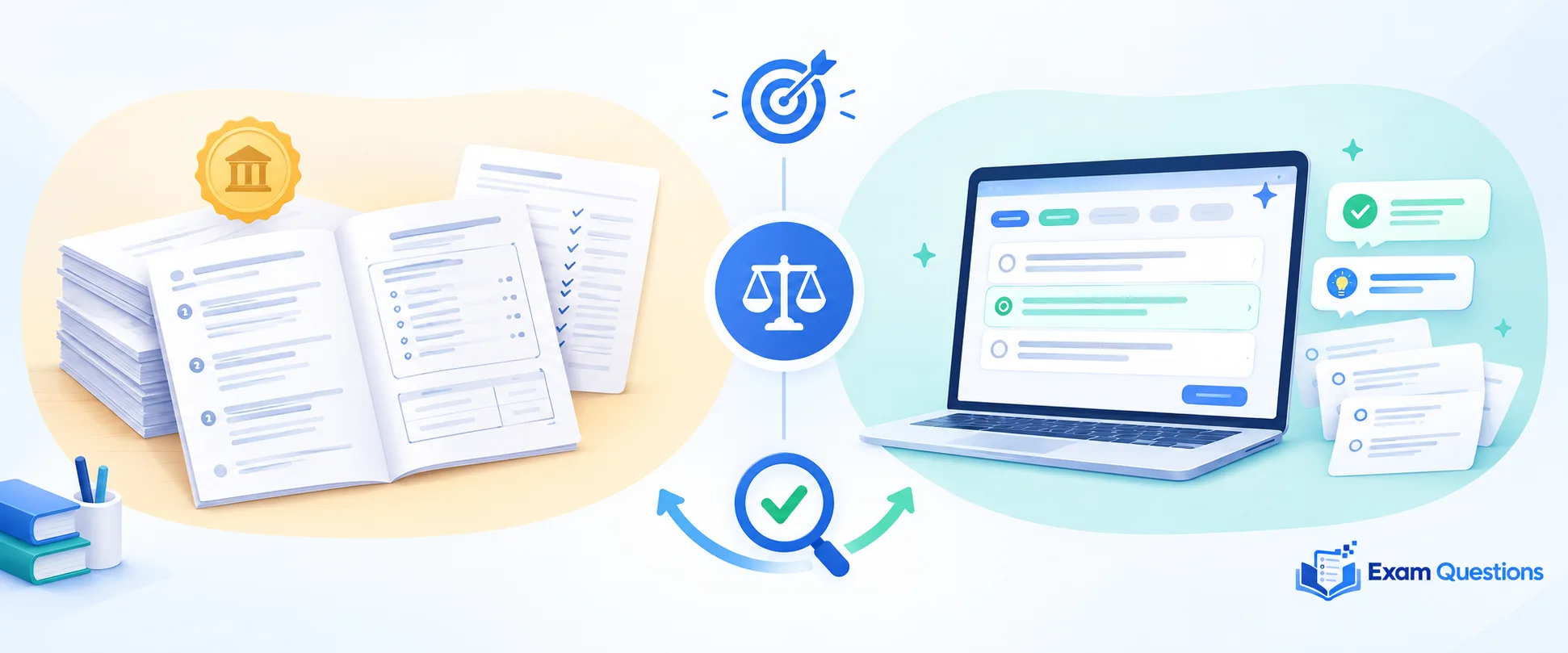
Ask students how they prepare for A Level exams and you'll hear a lot about hours: how many they put in, how early they start, how late they stay up. You'll hear much less about what those hours are made of. Two students can sit at a desk for the same three hours, and one of them improves while the other simply feels tired.
This guide is about making the hours count. It covers the whole path, from learning the content in the first place through to the final week: reading the syllabus properly, deciding what deserves your time, planning a week you can actually keep, practising from memory instead of rereading, using official papers well and keeping track of what keeps going wrong. Examples from Mathematics, Physics, Chemistry and Biology show how the same method bends to different subjects. If you are weighing official papers against AI-generated practice, see our comparison of past papers vs AI exam practice. If you're choosing between platforms, see how to choose an online learning platform for A Level students, and for the school side, see how schools can use an LMS to support A Level students.
Details differ by subject and exam board, and your teachers know your course best, so treat this as a framework to adapt. Keep your current syllabus open while you read, and have a look at the page for your own subject, such as A Level Mathematics or A Level Physics, to see the topics in one place.
Know Exactly What You're Preparing For
Most preparation problems begin with a vague target. "Revise Chemistry" is not a task. "Cover the section on enthalpy changes and answer ten questions on it" is. The syllabus is what turns the first into the second.
For Cambridge International A Levels, the syllabus is published on the exam board's official website, Cambridge International, and the same site hosts past papers, mark schemes and, for many subjects, specimen papers and examiner reports. Download the current syllabus for each subject and read three parts of it closely.
- 1
The content list. This is what can be examined. Copy the headings into one document per subject. Our topic pages show what the platform lists for each subject and are a handy companion.
- 2
The assessment section. It describes each paper: how long it lasts, what kinds of question it contains and how many marks it carries. A paper of short structured questions is prepared for differently from one built around long answers.
- 3
The command words and skills. Words such as state, describe, explain and evaluate ask for different things. Learn what your syllabus says each one means.
Syllabuses are updated, so make sure you are reading the version that applies to your exam series. Your teacher can confirm this in a minute.
Decide Where Your Time Should Go
You will never have time to treat every topic equally, and you shouldn't try. A simple scoring method makes the choice less emotional. For each topic, give three quick ratings from one to three.
| Rating | Question to ask | Higher score means |
|---|---|---|
| Weakness | How shaky am I on this? | I need to work on it |
| Weight | How much of the paper does this topic tend to carry? | It's worth more marks |
| Effort | How quickly could I realistically improve? | A little work could gain a lot |
Add the three scores. A topic that is weak, heavily examined and quick to fix goes to the top, and one that you already know well and that carries little weight goes to the bottom. The numbers are rough, but the act of scoring forces you to look at the whole subject instead of drifting towards the topics you like.
Do the same across subjects. If one subject is clearly further behind, it earns a bigger share of your week, but every subject needs at least one regular slot. A subject left for a month costs more to restart than it would have to keep warm.
Studying and Revising Are Different Jobs
A great deal of exam anxiety comes from mixing these up. Studying means meeting content for the first time, or properly understanding something that never clicked. Revising means going back over material you already understand so that you can recall and use it reliably.
| Aspect | Studying | Revising |
|---|---|---|
| Purpose | Understand new or unclear material | Make known material retrievable |
| Typical methods | Reading, worked examples, asking questions, small practice sets | Recall from memory, mixed questions, timed work |
| Feels like | Effortful and slow | Quicker, with some uncomfortable gaps |
| When | Throughout the course, and again if revision shows a gap | Increasingly as exams approach |
If revision reveals that you don't understand something, go back to studying mode for that topic, then return to revision. Trying to memorise something you haven't understood is slow and fragile, and it tends to fall apart in an unfamiliar question.
A Realistic Week Beats an Ideal One
Plans fail because they assume energy you won't have. Build yours around the real shape of your week, with school hours, travel, other commitments and rest. Here is one example for a student with three A Level subjects. The hours are illustrative, so shrink or stretch them to fit your own life.
| Day | Slot | What happens |
|---|---|---|
| Monday to Thursday | Evening, about 90 minutes | Two blocks of 40 minutes, one subject each, with a break: recall first, then questions |
| Wednesday | Evening, about 30 minutes extra | Mistake-log review and a short recall quiz on last week's topics |
| Friday | Evening, about 45 minutes | Light session: flashcards or summary sheets, nothing new |
| Saturday morning | About 2 hours | A timed section of a past paper in your weakest subject, then marking |
| Saturday afternoon | Free | Rest, exercise, friends |
| Sunday evening | About 45 minutes | Fix the week's errors, then plan the next week's targets |
Two features are worth copying whatever your schedule. First, every week contains at least one block where you work on real exam questions under some time pressure. Second, every week ends with a short review of what went wrong, because otherwise the same mistakes simply repeat.
Active Recall and Spaced Revision in Practice
Rereading is comfortable because everything looks familiar, and familiarity is easy to mistake for knowledge. Active recall is the opposite: you close the page and try to produce the material yourself. It is slower and more tiring, and it is the main reason some revision works and some doesn't.
Blank-page recall. Write down everything you can remember about a topic, then compare with your notes and mark the gaps in a different colour.
Question-first revision. Before reading a section, try the end-of-topic questions. What you can't answer tells you what to read.
Flashcards for facts. Definitions, formulae, key terms and sequences suit cards well. Test yourself in both directions.
Teach it. Explain a topic aloud as if to a younger student. Wherever you stumble is where the understanding is thin.
Spacing means returning to a topic after gaps instead of cramming it once. One commonly used pattern is to revisit a topic a day later, then a few days after that, then after a week or two, and again after a month. The exact intervals matter less than the principle: each return should feel slightly hard, because that slight difficulty is what strengthens memory.
Using Official Papers, Specimen Papers and Examiner Reports
Of everything you can revise from, official material is the closest to the real thing. Each kind has a slightly different job.
- Past papers show real questions in real exam style. Use them in small pieces early, then as full timed papers later. You can browse them on our A Level past papers pages.
- Mark schemes show exactly how marks were awarded, including the wording that earns credit. Mark every paper with the official scheme, and be strict with yourself.
- Specimen papers, where they are available for your syllabus, show the style and structure of the current course. They are especially useful when a syllabus has changed and older papers no longer match.
- Examiner reports, where available, describe how candidates actually answered and what went wrong. They are one of the most underused resources there is.
Papers are a limited supply, so keep the most recent ones back for the final weeks and use older papers or topic questions earlier. Always check that a paper matches your syllabus code and, as far as possible, the current version of your course. Our guide on past papers vs AI exam practice compares them with AI practice in detail.
Timed Practice and Learning From the Mark Scheme
Knowing the material and answering questions on it within the time are different skills, so practise the second one deliberately. Start with a loosely timed set of questions, move to a timed section, and sit full papers under proper conditions in the last weeks. Check your paper's duration and total marks first, since these differ between papers.
What you do after the paper matters as much as the attempt. Mark it strictly with the official scheme, and read the scheme as a guide to how answers are judged, not only as a list of correct answers. Notice the wording it expects, the points it separates and where your answer was vague. Then rewrite the answers you got wrong, without copying the scheme.
Track Your Mistakes Like Evidence
A mark lost is information, and a mark lost twice is a habit. A mistake log is the simplest way to turn the first into progress and stop the second.
| Topic | What went wrong | Type | Fix |
|---|---|---|---|
| Enzymes | Wrote "killed" instead of "denatured" | Vocabulary | Add the term to a flashcard and use it in an answer |
| Differentiation | Sign slip in the second step | Careless | Write each step on its own line and check the signs |
| Circular motion | Used the wrong formula for the situation | Method | Redo two similar questions and state the principle first |
| Mole calculations | Forgot to convert cm³ to dm³ | Units | Make unit conversion the first line of every calculation |
Review the log weekly and count the types. If careless slips dominate, you need a checking routine. If knowledge gaps dominate, you need more studying. The pattern tells you what kind of work to do next.
The Same Method, Four Subjects
The framework stays the same, but the emphasis shifts with the subject.
Mathematics. Practise problems on one skill at a time and show full working, since method marks matter. Revisit older topics regularly, because maths decays quickly when unused. See A Level Mathematics.
Physics. Pair calculations with explanations. Track units and significant figures, and practise writing a principle in words before you use an equation. See A Level Physics.
Chemistry. Alternate calculations with organic pathways and explanations, and learn reagents and conditions precisely. Practise writing balanced equations with state symbols. See A Level Chemistry.
Biology. Prioritise terminology and structured answers, with a clear chain from cause to mechanism to effect. Practise reading data carefully and quoting figures. See A Level Biology.
The other supported subjects follow the same logic. Browse them all on our A Level subjects page.
Getting Help Without Losing Your Own Effort
Your teachers are the first and cheapest source of help, so bring them specific problems rather than general worry: a question you keep getting wrong, a mark scheme point you don't follow, a topic that won't make sense. Specific questions get specific answers.
Some students also use a tutor for particular gaps. If you do, aim the lessons at a defined problem, and keep doing your own practice between sessions, because the learning still happens in your own head. If you are still choosing a school or college, check that the subjects you need are offered and ask how they support exam preparation. For choosing a digital platform, see how to choose an online learning platform for A Level students. Schools can read how schools can use an LMS to support A Level students.
Where Exam Questions Can Fit In
Exam Questions is an optional resource built around Cambridge International A Level subjects. As described on our AI exam preparation page, you can choose a subject and topic, generate additional exam-style questions, attempt them, check your answer and ask for an explanation. You can also look at real papers on the past papers pages and try questions on our A Level practice pages.
It is a tool for extra practice and feedback, not a replacement for your own effort, your teachers or official papers, and it can't predict what will appear in an exam. As with any tool, check anything important against your syllabus and the official mark scheme. Features change over time, so look at the site for what is currently available. For how AI practice compares with official papers, see past papers vs AI exam practice.
The Last Few Weeks
- Shift from learning new material to making what you know reliable.
- Sit full past papers at the real time of day, and mark them carefully.
- Fix the specific errors in your log instead of revising everything again.
- Plan the days between exams, so you aren't deciding while stressed.
- Protect sleep, meals and a little time outside. A tired brain recalls less.
Common Preparation Mistakes
- Starting with notes instead of the syllabus. You end up beautifully prepared for the wrong things.
- Confusing familiarity with knowledge. If you only reread, you haven't tested yourself.
- Saving past papers for the end. Use them in pieces from the middle of the course.
- Marking generously. Marks you nearly earned are marks you didn't earn.
- Ignoring weaker subjects. Avoidance feels good and costs marks.
- Copying someone else's timetable. A plan has to fit your energy and your commitments.
Final Thoughts
Good preparation is not mysterious. Know what the syllabus asks, decide where your effort should go, build a week you can keep, retrieve instead of reread, practise with official papers, learn from the mark scheme and track what goes wrong. None of it guarantees a particular grade, but it makes sure your hours go where they can do the most good.
Start this week with one small step: pick a subject, score its topics and plan the first three sessions. Then open the A Level syllabus page and begin.
Practise the subjects you choose
Work through topic questions and past papers for your A Level subjects, and get your answers marked with the reasoning behind each mark.