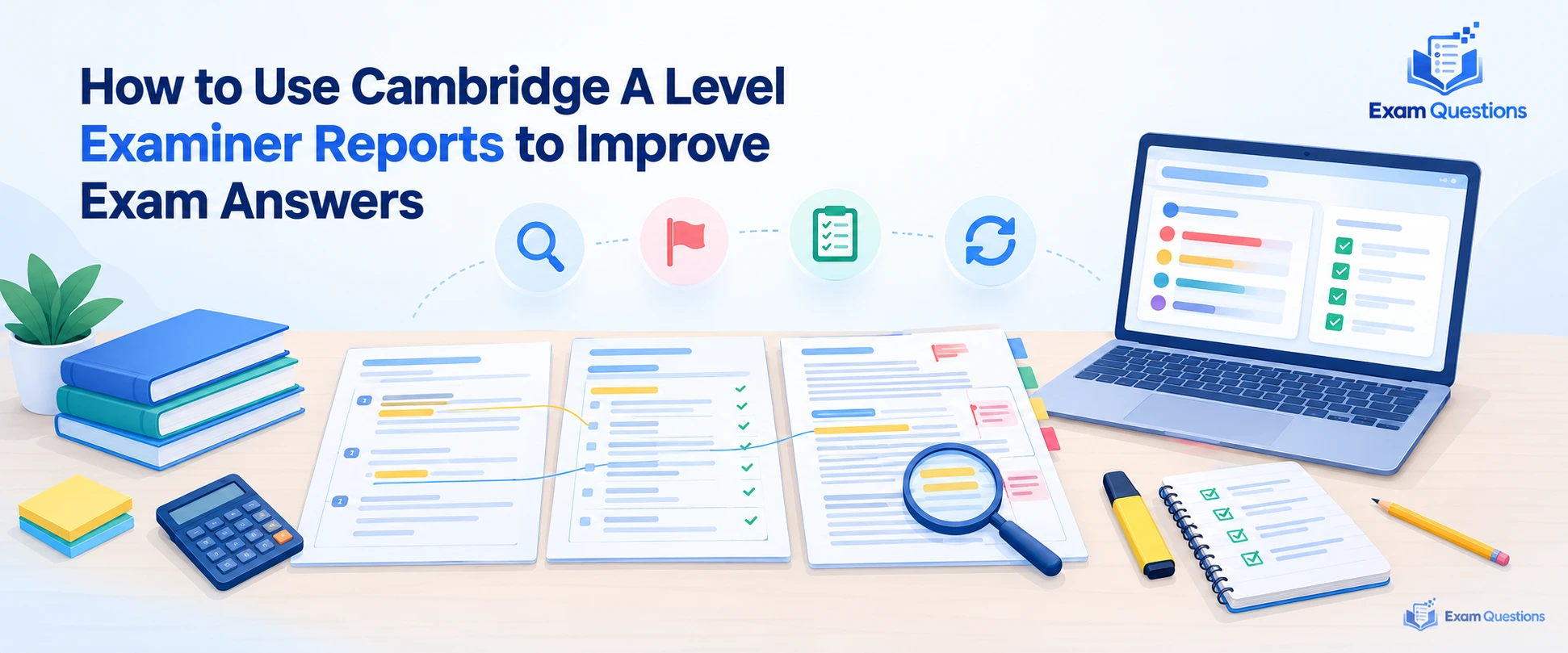
Most students who use past papers read the questions and the mark scheme. Far fewer read the examiner report, even though it is the one document that tells you how real candidates actually did, and where they went wrong. It is a bit like having the marker's notes after a performance: not a list of right answers, but a record of what happened when thousands of students sat the same paper.
This guide shows how to use examiner reports as a diagnostic tool. It explains how they differ from mark schemes and grade thresholds, how to find the right one for your subject and exam series, how to read it alongside the paper and how to turn its comments into a checklist you can use in your own answers. It works well with our guides to A Level command words explained and how to answer explain, describe and discuss questions, because examiner comments so often point back to the way a question was read and answered. For data-based questions, a frequent source of lost marks, see how to answer data-response questions.
Availability and format vary by exam board, subject and series, so use this as a method rather than a promise that every report looks the same. For Cambridge International A Levels, past papers, mark schemes and syllabuses are published on the exam board's website, Cambridge International, and your teacher can tell you how to reach any examiner reports provided for your subject.
Examiner Reports, Mark Schemes and Grade Thresholds
Three documents are often confused, because they all appear to be "about marking." They do different jobs.
| Document | What it tells you | How you use it |
|---|---|---|
| Mark scheme | How marks are awarded for each question, including acceptable answers | To mark your own work strictly and learn the wording that earns credit |
| Examiner report | How candidates in that series answered, and common strengths and errors | To diagnose weaknesses and learn what to avoid |
| Grade thresholds | The marks that were needed for each grade in that series | To understand how marks relate to grades, with the caution that they change from series to series |
The mark scheme says what an examiner is looking for. The examiner report says what they actually saw. And thresholds describe where the grade lines fell on one occasion, so they are not a target to copy, since they can differ between series. Keeping the three apart stops you drawing the wrong conclusion from the wrong document.
Finding the Right Report
A report is only useful if it matches the paper you're looking at. Check four things before you read a word.
- 1
The subject and syllabus code. For example, the code printed on the front of the paper and on your syllabus.
- 2
The exam series. Reports refer to a specific session, so make sure it matches the paper you have.
- 3
The component. Subjects have several papers, and each is usually discussed separately. Match the paper or component number.
- 4
The syllabus version. If the syllabus has been updated since, older comments may describe content or question styles that no longer apply.
If you can't find a report for the paper you want, that's not unusual. Availability differs, so ask your teacher or exam officer where reports for your subject can be accessed. In the meantime, our A Level past papers pages list real papers by subject, and our syllabus pages help you check which syllabus a paper belongs to.
What an Examiner Report Usually Contains
The layout varies, but many reports follow a similar pattern, and knowing it helps you read efficiently.
- General comments on how the paper went overall, such as which skills were handled well and which weren't.
- Key messages or advice for future candidates, sometimes as a short list.
- Question-by-question comments describing typical good answers, common errors and, sometimes, examples of misunderstandings.
- Observations on exam technique, such as reading the question, managing time and showing working.
If you only have time for part of it, read the general comments and the comments for the questions where you lost the most marks.
How to Read One Usefully
- 1
Have the paper and the mark scheme beside you. A comment about "question 4(b)" means little without question 4(b) in front of you.
- 2
Attempt the paper first. You'll notice more when you've struggled with the same questions yourself.
- 3
Read the report question by question. Mark the comments that describe what you did.
- 4
Highlight the repeated words. Phrases such as "many candidates" or "a common error" point to patterns.
- 5
Note what strong answers did. Reports often describe what the best candidates included. That is as useful as the errors.
- 6
Write down one action per finding. A comment you don't act on is just reading.
Be careful to read comments in context. A report describes candidates in one series, and an error that was common then may not be your error. Use it as a mirror to check your own work against, not as a list of things to worry about.
Spotting Recurring Misconceptions and Errors
Examiner comments tend to fall into a handful of families. Sorting them as you read makes the patterns obvious. The examples below are illustrations written in the style of such comments, not quotations from any report.
| Family of error | What a comment might say | What it tells you to practise |
|---|---|---|
| Knowledge gap | "Candidates were unsure of the definition." | Learn the precise definition and test yourself on it |
| Vocabulary | "Terms were used loosely, such as 'killed' for 'denatured'." | Build a list of exact terms for your subject |
| Command word | "Many described rather than explained." | Practise the shape each command word needs |
| Data and graphs | "Figures were not quoted from the table." | Quote values and units in descriptions |
| Method and working | "Working was not shown, so no credit could be given." | Show every step, line by line |
| Time and structure | "Answers to the final question were incomplete." | Practise pacing and leaving time for the last question |
Notice how many of the families connect to skills covered elsewhere on this site. If a report keeps saying "described rather than explained", our guide on how to answer explain, describe and discuss questions shows what the right shape of answer looks like, and our overview of A Level command words covers the wider list. For the data and graphs family, see how to answer data-response questions.
Turning Comments Into a Checklist
A report is only useful if it changes what you do. The simplest way is to convert each recurring comment into a short, checkable instruction.
| Examiner comment (illustrative) | Checklist item for your own answers |
|---|---|
| "Candidates did not use the data provided." | Quote at least two values from the table or graph, with units |
| "Explanations lacked a clear link between cause and effect." | Check each explanation for a because, and link each step to the next |
| "Many answers were not related to the context." | Refer to the situation in the question in every paragraph |
| "Calculations were set out unclearly." | Write each step on its own line and give the unit with the answer |
| "Several candidates did not complete the paper." | Check progress at the halfway point and move on from stuck questions |
Keep the checklist short, five or six items at most, so you will actually use it. Before you hand in a practice answer, run through it. After each paper, add any new item and remove any you no longer need.
Reading Several Series to Find Patterns
One report shows one series. Reading two or three for the same subject and component shows what keeps recurring, and recurring points are the most reliable ones to act on.
| Series | Comment | Seen before? | Action |
|---|---|---|---|
| Series A | Terms used loosely in explanations | First time | Add to vocabulary list |
| Series B | Terms used loosely, data not quoted | Yes (vocabulary) | Prioritise vocabulary; start data practice |
| Series C | Data not quoted | Yes (data) | Make data quoting a standing checklist item |
A tracking table like this is deliberately small. Its job is to show which comments return, so that you spend your limited time on those.
A Worked Example: From Comment to Action
Imagine a Physics student marks a past paper and loses marks on three calculation questions. She opens the examiner report for that paper and finds a comment in the style of: "Many candidates reached the correct numerical value but omitted the unit or gave the answer to an inappropriate number of significant figures." That is an illustrative comment, not a quotation, but it matches her marked paper exactly.
She doesn't stop at "I should be more careful." She turns it into an action: add a final line to every calculation that states the unit and checks the precision against the data. She puts that line on her checklist, tests it on her next two practice papers and counts how many unit and precision marks she still loses. When the count drops to zero, she replaces the item with whatever the next report suggests. The whole loop, from comment to checklist to retest, takes a few minutes, and it targets marks that are very cheap to win back.
A Short Note for Teachers and Parents
If you are helping a student, the most useful thing is to ask what they learned from a report, not whether they read it. A good answer names a recurring weakness, says what they will do about it and describes how they'll check it worked. Teachers are also well placed to explain which comments are specific to a series and which reflect lasting habits.
What Examiner Reports Can't Do
- They don't predict. A report describes one series, and it doesn't tell you what the next paper will ask.
- They don't replace the mark scheme. To see exactly how marks were awarded, you still need the mark scheme.
- They aren't a grade guide. They don't set or explain grade boundaries, and thresholds change between series.
- They don't know you. Comments describe candidates in general, so check your own work before you assume an error applies.
Treat reports as one piece of evidence alongside your own marked work, your teacher's feedback and the syllabus.
Fitting Reports Into Your Practice
Examiner reports work best at a particular moment: after you have sat and marked a past paper yourself. Reading the report then lets you compare your errors with the ones examiners saw, and lets you fix both in one go. You can use the same loop with questions from our A Level practice pages: attempt, mark strictly, read what examiners say about similar questions and add one item to your checklist.
Common Mistakes When Using Examiner Reports
- Using the wrong report. A different series, component or syllabus can mislead you.
- Reading without the paper. Comments make little sense without the questions in front of you.
- Confusing it with the mark scheme. The two answer different questions.
- Collecting comments without acting. Every finding needs one action.
- Treating thresholds as targets. They describe one series and move.
- Over-reading. One comment about one question isn't a rule for every paper.
Final Thoughts
An examiner report is feedback from the people who read thousands of real answers, and it costs you nothing but attention. Find the right one, read it beside the paper and the mark scheme, sort the comments into families, spot the ones that recur and turn them into a short checklist you really use.
For the skills the comments so often point to, read our guides on A Level command words explained and how to answer explain, describe and discuss questions. Then choose one past paper you've already marked, find its report and write down one action.
Practise the subjects you choose
Work through topic questions and past papers for your A Level subjects, and get your answers marked with the reasoning behind each mark.