"Which class are you in?" is one of the first questions a Pakistani student gets from a relative, a neighbour or a form. For most people the answer is a number. For a student on the British curriculum it isn't, because A Levels don't come with class numbers, and that's why so many families end up asking what an A Level means and where it fits.
The plain answer is that A Level sits at the stage most people call Class 11 and 12, the two years before university. Our guide on what A Level is in Pakistan covers the qualification itself, and our article on whether A Level is equal to Class 11 and 12 covers the official equivalence. This one is the friendly middle: it explains the name, the stage and what to say when someone asks.
We'll keep to what's true for most Pakistani students, which means Cambridge International exams, and you can browse the A Level subjects as you read. Details differ between schools and boards, so check the current rules with your own school before relying on any date or number here.
What the Name "A Level" Means
The "A" in A Level stands for Advanced. The full name is the General Certificate of Education Advanced Level, which is a mouthful, so everyone shortens it. If you've seen it written as GCE A Level, it's the same thing.
"Advanced" tells you where it sits. It comes after the "Ordinary" level, which is why O Level exists. O Level is the earlier stage, built around a broad set of subjects. A Level is the later one, where you study a few subjects in much more depth. So when people ask what A Level stands for, the answer is really a clue to the order: Ordinary first, then Advanced.
AS and A2
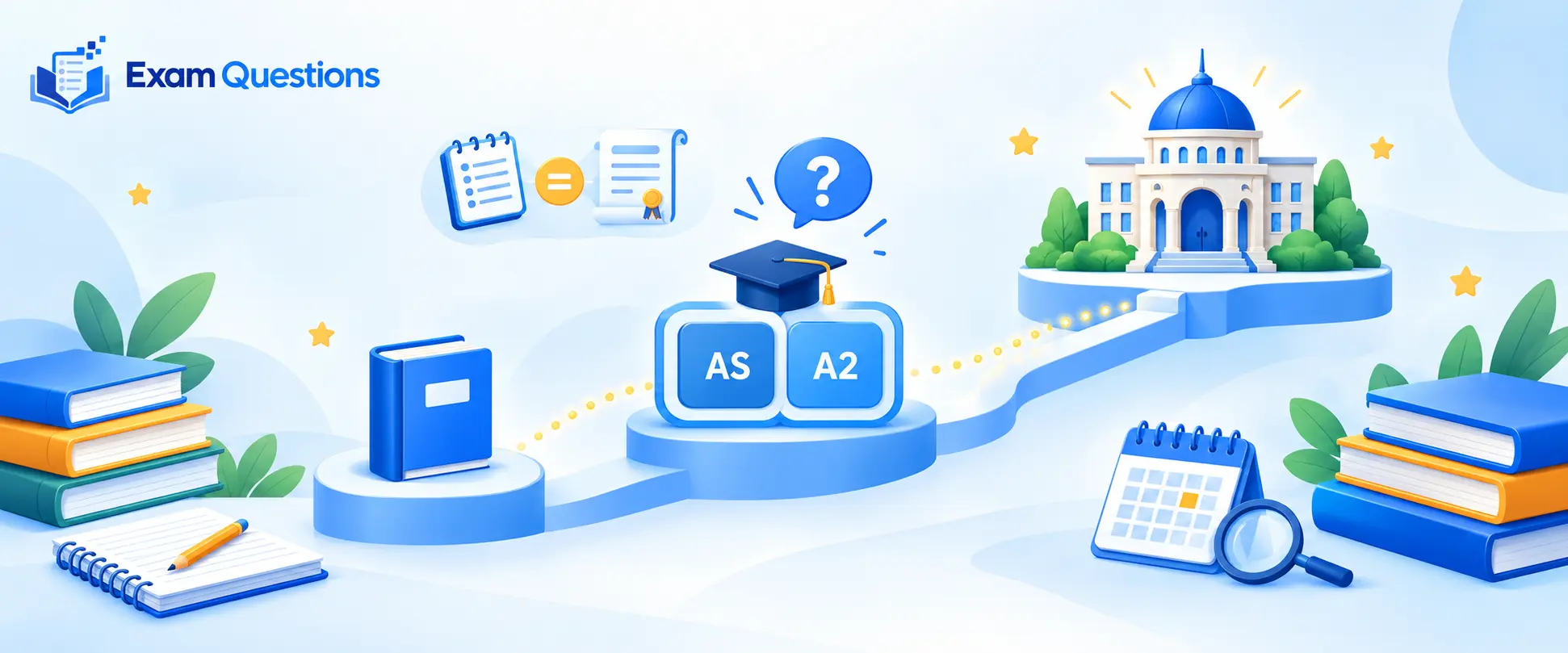
You'll also hear AS Level and A2. AS stands for Advanced Subsidiary and is the first half of the course. A2 is the second half. Together they make up the full A Level. Many students sit AS exams at the end of the first year and A2 at the end of the second, though schools handle the timing in different ways.
Why the "Class" Question Comes Up at All
Pakistan's local system counts in classes. You go from Class 1 up through Class 10, and then to Class 11 and 12, which together make Intermediate. The British curriculum counts differently: it talks about stages and exams, such as IGCSE, O Level and A Level, and in the UK about year groups.
Because the two systems use different vocabulary, there's no number printed on an A Level certificate. That's perfectly normal, but it leaves families translating between the two whenever a form, a relative or a university asks for a class. The good news is that the translation is well understood, and it isn't a matter of guesswork.
Where A Level Sits in the Education Journey
It helps to see the whole path from school to university. The names change depending on which route a student follows, but the order doesn't.
- 1
Primary and middle school. Roughly Class 1 to 8. Most students follow the same broad pattern whichever curriculum their school uses.
- 2
Secondary school. Roughly Class 9 and 10 in the local system, ending in Matric. On the British route this stage ends in IGCSE or O Level exams.
- 3
Higher secondary. The stage most people call Class 11 and 12. Local students take FSc, FA or ICom. British-route students take A Levels.
- 4
University. Whichever route you took, this is where both paths meet. Pakistani universities accept A Levels through an equivalence certificate.
The key point is that A Level isn't a step above Intermediate. It's a parallel route through the same stage, which is why the two lead to the same place.
Stages Side by Side
This table puts the two routes next to each other. The ages are typical, and individual students can be a year either side.
| Stage | Local system | British curriculum route | Typical age |
|---|---|---|---|
| Secondary | Class 9 and 10, ending in Matric | IGCSE or O Level | About 14 to 16 |
| Higher secondary, year one | Class 11 (first-year Intermediate) | AS Level | About 16 to 17 |
| Higher secondary, year two | Class 12 (second-year Intermediate) | A2 Level | About 17 to 18 |
| After school | University | University | About 18 and above |
Some schools run O Levels over three years instead of two, so the local numbers and the British stages don't always line up neatly. If your school does this, it doesn't change what A Level is equal to. It only changes how many years the student spent before reaching it.
Year by Year: Class 11, Class 12 and the Missing Class 13
In the first year of A Levels, students usually study AS content, and that year is roughly Class 11. In the second year they study A2, which is roughly Class 12. Neither year is called Class 11 or Class 12 by the school or the exam board. Those labels are the local shorthand people reach for.
Some families hear "two years after O Level" and assume that adds up to Class 12 plus an extra year, so they start calling A Level Class 13. That's a mix-up. The A Level course is the two years of Class 11 and 12 in the other system, so there's nothing beyond Class 12 in the school stage. Class 13 doesn't exist as a school class.
If you'd like the official side, our guide on how A Level equals Class 11 and 12 explains the process and what the equivalence is used for.
What the Two Years Actually Look Like
Knowing the stage is one thing. Knowing what happens inside it is more useful, especially if you're a parent wondering what the next two years will ask of your child.
- 1
The first year (AS). The student settles into three or four subjects, usually with a lot more independent study than at O Level. Many schools hold internal tests through the year, and AS exams may come at the end of it, depending on the school's plan.
- 2
The second year (A2). The content gets deeper and the exams matter most. This is also the year when university applications, entry tests and the equivalence paperwork all land together.
- 3
Results and what follows. Exam results arrive after the final session, and Pakistani universities will want an equivalence certificate alongside them. Planning that step early avoids delays.
Seen this way, the question "which class?" is really a question about timing. Year one is the foundation, year two is the finish, and what you do in the first one shapes how the second goes.
A Level and Intermediate: Alike in Position, Different in Style
They sit in the same place in the journey, but they work differently. Intermediate usually gives you a fixed group of subjects, often including compulsory ones, and tests a broad range of content. A Level lets you choose a small number of subjects, usually three, and goes deeper into each. The exams are set and marked by an international board instead of a local one.
Neither is automatically better. What matters is which one suits your plans and your school. For a fuller comparison, see our guide on what A Level is in Pakistan, which sets out the differences in detail.
What to Write When a Form Asks for Your Class
This is the practical problem behind the question, so here's a simple approach. Use the same idea every time: say what you're studying, not a number you've invented.
School and college forms. Write A Level, and add the year, such as AS or A2. If there's a box for class, ask the school what they'd like to see there, since many already know how to handle it.
University applications. Give your A Level subjects and grades as the form asks. Pakistani universities will ask for an equivalence certificate separately.
Scholarships and competitions. Check the eligibility wording. Many say "Intermediate or equivalent", which is where A Level fits. If the wording is unclear, ask the organiser.
Everyday conversation. It's perfectly fine to say "I'm doing A Levels, the equivalent of Class 11 and 12." Most people understand that straight away.
When a rule or form is strict, don't rely on a guess. Ask the body that wrote it. You can estimate how your results will convert with our A Level equivalence calculator, but the official figure comes from the certificate.
Three Students, Three Practical Answers
A few everyday situations show how this plays out. They're simplified, but they cover the cases families run into most.
Ayesha, applying to a local medical college. She's finishing A2 in Biology, Chemistry and Physics. She describes her level as A Level, applies for the equivalence certificate through the official process and checks the college's published requirements for the subjects and marks it wants.
Hamza, filling in a scholarship form. The form asks for his "class". He writes A Level (AS), adds his subjects and adds a note that it's equivalent to Class 11. Then he checks the eligibility wording to make sure A Level students qualify.
Sara's parents, answering relatives. When people ask Sara's class, they say "She's doing A Levels, the same stage as Class 11 and 12." It's short, accurate and almost always understood.
A Few Terms That Get Mixed Up
O Level. The earlier qualification, usually taken at the end of secondary school. It sits roughly where Matric does.
IGCSE. A similar qualification to O Level, from the same family. Many schools offer one or the other, and both lead to A Levels.
AS Level. The first half of A Level. It's a qualification in its own right, but on its own it's treated as worth less than a full A Level.
A2. The second half. The AS and A2 results together make the full A Level grade.
Cambridge and Edexcel. The two exam boards schools in Pakistan commonly use. Cambridge is the more widespread. The names of the subjects are broadly the same, but the details differ.
Why You Might Hear "Year 12" and "Year 13"
A Level comes from the British system, where school years are counted as Year 1 and upwards. The two A Level years there are called Year 12 and Year 13, often grouped as sixth form. Some schools in Pakistan borrow those names, so you may see Year 12 and Year 13 in a timetable or on a school website.
They map onto the same two years: Year 12 is the first A Level year and Year 13 is the second. In the UK that's one more number than the local Class 11 and 12, which is part of why "Class 13" gets muddled. The simple fix is to remember that the number you see depends on whose counting system the school is using, and the stage underneath is the same.
When Relatives and Neighbours Ask
It's worth having an answer ready, because the question comes up constantly and a muddled reply sparks more questions. A line that works for most people is: "A Levels, which is the same stage as Class 11 and 12." If they ask which board, say Cambridge or Edexcel. If they ask about universities, say that A Level results are converted into a local equivalence certificate.
Keep it short. You don't need to explain AS and A2 or the grading unless someone asks. A clear, calm answer shows you understand the route, and that tends to end the conversation sooner than a long explanation would.
Common Confusions
- 1
"A Level is a degree." It isn't. It's a school-stage qualification that you take before university.
- 2
"A Level is Class 13." There's no Class 13. A Level covers the same two years as Class 11 and 12.
- 3
"A Level is higher than Intermediate, so it's tougher to get into university with it." Neither is higher in the school sense. They run in parallel, and A Level results are converted through an equivalence process.
- 4
"You can't study medicine or engineering with A Levels." You can. What matters is your subjects, your grades and the university's requirements.
- 5
"The class number decides everything." For admissions, your subjects and grades count for far more than the label you give your level.
What Matters More Than the Class Number
The label is useful for conversation, but it isn't what a university looks at. Admission teams look at your subjects, your grades and, for Pakistani universities, your equivalence certificate. That means the energy you spend worrying about the right word for your class is better spent on picking subjects that fit your degree and preparing well for the exams.
If you're still deciding on subjects, our A Level subjects page shows what's on offer. The syllabus pages show what each course covers, so you can judge a subject by its content.
Questions to Ask Your School
- Which exam board and syllabus codes do you use for each subject?
- How does the school describe the A Level years in its own paperwork, for example AS and A2, or Year 12 and Year 13?
- Will you help with the equivalence certificate, and when should we apply?
- How is the first year organised, and when are AS exams held?
- What happens if a student changes subjects after the first year?
Getting Ready for the A Level Stage
However you label the stage, the step up from O Level is real. The content goes deeper, and the exams expect you to apply ideas, not just recall them. Starting early helps. Read the syllabus for each subject, keep your O Level foundations in good shape, and practise real exam questions regularly.
Our A Level past papers and topic pages help you see what the exams look like, and the practice pages and A Level questions give you something to work through. If you'd like help organising revision, our AI exam preparation guide shows how to use AI as a study partner without letting it do the thinking.
Final Thoughts
A Level means Advanced Level, and in Pakistan it sits at the stage most people call Class 11 and 12. It runs alongside Intermediate and leads to the same place: university. There's no Class 13, and the label matters far less than your subjects, your grades and your preparation.
For the full picture, read our guide on what A Level is in Pakistan and our article on how A Level equals Class 11 and 12. Together with this guide, they answer almost every version of the question.
Practise the subjects you choose
Work through topic questions and past papers for your A Level subjects, and get your answers marked with the reasoning behind each mark.